Two items of note: one current, one forthcoming.
Out now is the book/guide, Hey Shorty!: A Guide to Combating Sexual Harassment and Violence in Schools and on the Streets.
It is based on the work done in the non-profit Girls for Gender Equity based on Brooklyn. The group is "committed to the physical,, psychological, social and economic development of girls and women. Through education, organizing and physical fitness, Girls for Gender Equity encourages communities to remove barriers and create opportunities for girls and women to live self-determined lives." Based on Brooklyn, the group caters primarily to urban girls of color. Hey Shorty! (Feminist Press) presents the model developed by GGE on how to teach young people how to address and define sexual harassment as well as some of its effects. According to the blurb, the guide is "geared toward students, parents, teachers, policy makers, and activists, this book is an excellent model for building awareness and creating change in any community."
We haven't seen a copy of the guide yet, but the "look inside" feature at the Amazon.com shows that Title IX is mentioned in the guide.
The title, by the way, is a common call heard by girls as they walk the streets of their communities and the halls of their schools. Shorty is slang for a "sexually attractive girl with both childlike and feminine attributes in terms of body and behavior." In other words, not innocuous and not having anything to do with one's height.
And, not out yet, but we're eagerly awaiting its release, is a documentary film (link to the Chronicle of Higher Education, subscription required to read the whole article), about the effects--or lack thereof--of Title IX in urban schools. The movie, In the Game, is from the production company that gave us Hoops Dreams and is at least a year away from being available to the public. Director Maria Finitzo features three different stories: an inner-city girls' soccer team, a professional women's basketball team, and a group of young girls in the Chicago public schools who are investigating issues of gender equity in their schools.
Even from the little I have heard thus far about the film, it seems like it will start to fill some of the gaps in the literature around the law and its application to urban schools and effects on the girls in those communities. And the stories look like they will be quite compelling.
Showing posts with label books. Show all posts
Showing posts with label books. Show all posts
Tuesday, April 19, 2011
Wednesday, October 06, 2010
Strike IX profiles the 1999 Providence College Baseball Team
When author Paul Lonardo contacted me about his new book Strike IX, I worried I might be in for another misplaced Title-IX-is-the-enemy screed from an advocate for men's sports. But after reading a copy of the book, which Paul kindly sent me, I learned that Strike IX is the story of the athletes on the 1999 Providence College men's baseball team who went on to have the season of their lives after the college announced its decision to cut the program. Strike IX is a compelling underdog story about athletes playing for pride, playing for the love of the game when there's no tomorrow, when the "only thing left to do is to go out and win the whole $*!@ thing!" Under these circumstances, the 1999 Providence College baseball team produced the best season record in the program's history and a Big East conference championship. It was, in sum, a good sports story.
The only problem I had was the title. Calling the book Strike IX creates the impression that Title IX was to blame for the college's decision to eliminate the team. And the chapter in the book that discusses the relationship between Title IX and PC's program reduction could have done more to clarify the statute's role. I have two specific critiques. First, while the author appropriately notes that PC made its decision to terminate baseball in the wake of the Title IX litigation involving Brown University, he leaves the impression that the decision created PC's obligation to comply with Title IX. Rather, the regulatory standard that Brown so gloriously unsuccessfully challenged in the early 1990s had been on the books since 1979. Unexamined in Strike IX was what Providence College's compliance approach had been since then. With twenty years to play with, did the institution seek to equalize men's and women's athletic opportunities gradually, so as to avoid a drastic approach like cutting teams? Or did PC behave cavalierly, like many colleges did, and exacerbate inequities by continuing to grow men's sports without first bringing women's sports up to level? It's true that Title IX limits school's choices about which teams to cut when that school fails to provide proportionate opportunities to begin with. But PC's decisionmaking prior to 1999 is what created that disproportionality, and some of that should have been in the book.
My second critique is that the author accepted too quickly PC's rhetoric about why it thought it had to satisfy the proportionality standard (and thus, to do so by cutting a men's team) rather than to claim compliance with prong three. Prong three recognizes that even disproportionate athletic offerings (like PC's at the time) can still comply with Title IX, as long as there is no demonstrable unmet interest among members of the underrepresented sex (i.e., women). Generally, an institution does not have a problem with prong three unless they (1) decide to cut a viable women's team (which PC did not do) or (2) reject a proposal from a women's club team to elevate to varsity status. Thus, if PC had been receiving and rejecting requests to elevate women's teams to varsity status, its claims that it "had to" comply with proportionality might ring true. But if not, it's more likely that the university was using Title IX to scapegoat its decision to engage in program reduction that it had made for others. Title IX prohibits schools like PC from making existing disproportionality worse through program reduction, which is why PC couldn't cut a women's team once it decided to cut teams, but it does not require a school to engage in program reduction to begin with. In PC's case, then, the decision to cut baseball was likely less related to Title IX than the college would have us think. That's the reality I would have liked to read about in Strike IX. Unfortunately, that doesn't lend itself to a clever book title.
The only problem I had was the title. Calling the book Strike IX creates the impression that Title IX was to blame for the college's decision to eliminate the team. And the chapter in the book that discusses the relationship between Title IX and PC's program reduction could have done more to clarify the statute's role. I have two specific critiques. First, while the author appropriately notes that PC made its decision to terminate baseball in the wake of the Title IX litigation involving Brown University, he leaves the impression that the decision created PC's obligation to comply with Title IX. Rather, the regulatory standard that Brown so gloriously unsuccessfully challenged in the early 1990s had been on the books since 1979. Unexamined in Strike IX was what Providence College's compliance approach had been since then. With twenty years to play with, did the institution seek to equalize men's and women's athletic opportunities gradually, so as to avoid a drastic approach like cutting teams? Or did PC behave cavalierly, like many colleges did, and exacerbate inequities by continuing to grow men's sports without first bringing women's sports up to level? It's true that Title IX limits school's choices about which teams to cut when that school fails to provide proportionate opportunities to begin with. But PC's decisionmaking prior to 1999 is what created that disproportionality, and some of that should have been in the book.
My second critique is that the author accepted too quickly PC's rhetoric about why it thought it had to satisfy the proportionality standard (and thus, to do so by cutting a men's team) rather than to claim compliance with prong three. Prong three recognizes that even disproportionate athletic offerings (like PC's at the time) can still comply with Title IX, as long as there is no demonstrable unmet interest among members of the underrepresented sex (i.e., women). Generally, an institution does not have a problem with prong three unless they (1) decide to cut a viable women's team (which PC did not do) or (2) reject a proposal from a women's club team to elevate to varsity status. Thus, if PC had been receiving and rejecting requests to elevate women's teams to varsity status, its claims that it "had to" comply with proportionality might ring true. But if not, it's more likely that the university was using Title IX to scapegoat its decision to engage in program reduction that it had made for others. Title IX prohibits schools like PC from making existing disproportionality worse through program reduction, which is why PC couldn't cut a women's team once it decided to cut teams, but it does not require a school to engage in program reduction to begin with. In PC's case, then, the decision to cut baseball was likely less related to Title IX than the college would have us think. That's the reality I would have liked to read about in Strike IX. Unfortunately, that doesn't lend itself to a clever book title.

Sunday, August 29, 2010
Another book for consideration
It must be book recommendation week here at the Title IX Blog. I think these are supposed to come at the beginning of the summer and not the beginning of fall when many of us are a little bit buried with back-to-school stuff and all those things we didn't get accomplished over the summer.
But this book is definitely at the top of my must-read list (note to Norton: I would be happy to review it here if I can get a copy!!). Delusions of Gender: How our Minds, Society and Neurosexism Create Difference by Dr. Cordelia Fine is her recently published manuscript about the construction of gender differences. Fine, a cognitive neuroscientist, takes aim at the many scientific studies that have continued to attribute gender differences to innate characteristics. Why do we--as in the Title IX Blog, not the general populace which should care a lot--care about this work?
Well for one, according to the review in the New York Times, it's a very well-written and accessible work. And secondly, Fine discusses the research done by doctoral student Jennifer Connellan that has been used to justify sex-segregated classrooms. And finally, I think it's time to add neurosexism into the gender equity lexicon.
But this book is definitely at the top of my must-read list (note to Norton: I would be happy to review it here if I can get a copy!!). Delusions of Gender: How our Minds, Society and Neurosexism Create Difference by Dr. Cordelia Fine is her recently published manuscript about the construction of gender differences. Fine, a cognitive neuroscientist, takes aim at the many scientific studies that have continued to attribute gender differences to innate characteristics. Why do we--as in the Title IX Blog, not the general populace which should care a lot--care about this work?
Well for one, according to the review in the New York Times, it's a very well-written and accessible work. And secondly, Fine discusses the research done by doctoral student Jennifer Connellan that has been used to justify sex-segregated classrooms. And finally, I think it's time to add neurosexism into the gender equity lexicon.
Thursday, August 26, 2010
A Title IX Must-Read: Getting In the Game
Hot off the press! Getting In the Game is a new book by Title IX expert Professor Debbie Brake from the University of Pittsburgh School of Law. In the book, Brake examines how Title IX has affected and continues to affect many facets of college and scholastic athletics for men and women. Chapter by chapter, Brake identifies and analyzes the hard and interesting questions that Title IX raises, including the appropriateness of separate teams in the first place, whether and when girls should be able to try out for boys' teams, how to measure equal opportunities (the three-part test), what counts as athletic opportunities (including the cheerleading issue), the effect of Title IX on men's sports, the effect of Title IX on women of color (for more, see here), what constitutes equal treatment, the tension between equal treatment and acknowledging sex-differences (the pregnancy issue), and general aspects of the law, such as protection against sexual harassment and employment discrimination, that apply to athletics as well.
Brake is not shy about her own opinions about where the law gets it right and in what ways it can improve. For example, Brake acknowledges the critique of Title IX that by allowing separate teams for men and women, the law has harmed women's sports by segregated women into sports that receive the least support, least prestige, and reinforce stereotypes about women's athletic inferiority. But, she argues persuasively that separate teams are needed to preserve opportunities for women -- to give them the chance to, essentially, get in the game. Relatedly, however, she critiques some of the limitations on co-ed participation, including the existing regulation that lets schools prevent girls from trying out for boys' teams in contact sports, as well as the limitation on co-ed participation in sports where both a girls team and a boys team is offered. Brake proposes that girls should be allowed to try out for boys teams in both contact and non-contact sports, and even if there is a girls team that exists in that sport, but where that team is not truly equal, due to different levels of support for teams, level of play, or status. This proposal addresses some of the anti-separatist concerns without abruptly curtailing the protection of women's opportunities that results from having a default of separate teams.
Throughout the book, Brake balances detail and context on the one hand with readability on the other. The result is a book that should appeal to a broad audience including legal experts, athletic administrators, student-athletics, parents, and fans.
For other endorsements, see here.
Brake is not shy about her own opinions about where the law gets it right and in what ways it can improve. For example, Brake acknowledges the critique of Title IX that by allowing separate teams for men and women, the law has harmed women's sports by segregated women into sports that receive the least support, least prestige, and reinforce stereotypes about women's athletic inferiority. But, she argues persuasively that separate teams are needed to preserve opportunities for women -- to give them the chance to, essentially, get in the game. Relatedly, however, she critiques some of the limitations on co-ed participation, including the existing regulation that lets schools prevent girls from trying out for boys' teams in contact sports, as well as the limitation on co-ed participation in sports where both a girls team and a boys team is offered. Brake proposes that girls should be allowed to try out for boys teams in both contact and non-contact sports, and even if there is a girls team that exists in that sport, but where that team is not truly equal, due to different levels of support for teams, level of play, or status. This proposal addresses some of the anti-separatist concerns without abruptly curtailing the protection of women's opportunities that results from having a default of separate teams.
Throughout the book, Brake balances detail and context on the one hand with readability on the other. The result is a book that should appeal to a broad audience including legal experts, athletic administrators, student-athletics, parents, and fans.
For other endorsements, see here.
Thursday, September 03, 2009
New Book Examines Challenges Facing Women Coaches
In her new (2009) book, Gender Games: Why Women Coaches Are Losing the Field, author Christina Cruz examines gendered dynamic of college athletic departments and the tensions that it creates for female coaches. These tensions, which Cruz labels "micro-competitions" likely explain why the percentage of coaches who are female has diminished from over 90% to 43% in the last thirty years. In presenting the narratives of five successful female coaches, Cruz uncovers numerous examples of micro-competitions, many of which the coach is powerless to win, that affect coaches' self-efficacy in aspects of the job outside of the role of coaching itself. The narratives provide examples of coaches negotiating between on-court and off-court personas, their efforts to satisfy athletic department and cultural expectations that are often in conflict, and the toll of working with and for unsupportive or hostile male colleagues. An overall finding is that "male-centered environments cause the coaches to pit themselves against patriarchal forces that promote male power over women and perpetuate preexisting gender regimes. This atmosphere leaves these female coaches vulnerable to self deprecation."
I really appreciate that Cruz then translates her findings into advice for both coaches, on the one hand, and athletic administrators and other "gatekeepers of power" on the other. She encourages female coaches to work together to help reposition those who are "at the margins" closer to the center of power. She encourages them to be aware of and to challenge men's "status
seeking games" and to stand up and challenge those who bully and harass women. Then she implores administrators to guard against inappropriate and oppressive behavior by staff, to create space for all to give input without being dominated by some, to assist coaches in achieving their goals, and to facilitate mentoring and professional development. It is hard to write a prescription to address entrenched cultural stereotypes and biases, many of which are subtle and easy to overlook ("micro") on an individual basis. Cruz's book does a good job not only shedding light on the nuances of the problem, but in addressing the problem in a coordinated and comprehensive way.
I really appreciate that Cruz then translates her findings into advice for both coaches, on the one hand, and athletic administrators and other "gatekeepers of power" on the other. She encourages female coaches to work together to help reposition those who are "at the margins" closer to the center of power. She encourages them to be aware of and to challenge men's "status
seeking games" and to stand up and challenge those who bully and harass women. Then she implores administrators to guard against inappropriate and oppressive behavior by staff, to create space for all to give input without being dominated by some, to assist coaches in achieving their goals, and to facilitate mentoring and professional development. It is hard to write a prescription to address entrenched cultural stereotypes and biases, many of which are subtle and easy to overlook ("micro") on an individual basis. Cruz's book does a good job not only shedding light on the nuances of the problem, but in addressing the problem in a coordinated and comprehensive way.
Tuesday, May 26, 2009
Stolen Bases: Why American Girls Don't Play Baseball
The topic of women and baseball is one frequently mentioned on this blog; just recently we posted about the Indiana teenager whose lawsuit integrated high school baseball in her state. There's also been much buzz lately about the International Baseball Federation's campaign to make women's baseball an Olympic sport (see, e.g., here, here, and here). It seems like the perfect time to plug Jennifer Ring's Stolen Baseball: Why American Girls Don't Play Baseball (University of Illinois Press, 2009).
From Stolen Bases, I learned that contrary to popular mythology, baseball was not invented in Cooperstown by Civil War hero Abner Doubleday. Rather, it evolved from the British sport of rounders, which was played by males and females alike. But in the early 1900s, the efforts of Albert Spalding -- of sporting goods fame -- to promote baseball as the "national passtime" positioned the sport as a means of masculinization and colonialism. ("He articulated a mission for American baseball men: use the sport to teach men from nonwhite races and non-European cultures to become civilized and rational on a while American middle-class model.") In fact, Spalding himself promoted the Doubleday myth to make the sport more uniquely American and exclusively masculine.
Meanwhile, men invented softball as a way to play baseball indoors during the winter. But the indoor version was so obviously a "pale imitation" of the real thing that it could be inclusive of women without tainting the association of baseball and manhood. Early physical educators endorsed also softball as a sport for appropriate for girls, which, Ring explains, "solved the problem of how to get exercise to the average, nonathletic girl without running the risk of supporting 'games of strife' that make America's girls too competitive, brave, strong, and passionate about something not in the service of men and family. And it was played indoors, discretely out of the view of spectators." Moreover, promoting softball for girls had the effect of redirecting women's documented interest and enthusiasm for baseball into a different sport, insidiously marginalizing them from the "national" passtime. Softball has come a long way since its early days as a safe, indoor game; women can now play the sport for college glory and on the Olympic stage (until 2012, anyway). But as a sport it clearly doesn't rival baseball in terms of its cultural significance. Baseball is the sport that receives media attention, that provides the backdrop for family bonding and business meetings, that serves its players as role models for boys and girls, and that offers salaried employment to thousands of athletes.
The paradigm of baseball/boys: softball/girls is so ingrained as to be rarely questioned or challenged. There are no legal restrictions to women's participation in baseball, as Ring explains. Lawsuits invoking the Constitution's Equal Protection Clause lead to the integration of Little League in the 1970s, and Title IX's regulations do not allow schools to exclude girls from trying out for baseball as they do for some contact sports. It is simply a matter of "preference" that keeps girls and women interested in softball instead of baseball. Of course, after reading the history of both sports as presented by Ring, it is clear that this "preference" has been, and continues to be, constructed by social forces that operate with the interests of men, not women, in mind. The few girls who defy the gendered convention and play baseball in Little League and even into high school likely "choose" to switch to softball in order to play at the college level. Women could, collectively, assert their right to participate visibly in baseball, and for college and Olympic opportunities to do so. But because there is no critical mass of women in the sport, individual women have little incentive to sacrifice the opportunity to participate in the established sport of sotball in order to do so.
Ring's final point is that, despite channelling effect of softball, women do play baseball -- "you just have to look hard to find them." There are regional leagues playing in obscurity (Ring calls it an "underground") and a women's national team that plays under the aegis of USA Baseball, the sport's national governing body, in a biennial women's world cup (a literal "world series"). It won't be easy to create -- or even envision -- a world where girls and boys can make a free and legitimate choice between two different sports, but after reading Ring's Stolen Bases, I believe that support and exposure to the girls who already do or want to play the game is a necessary first step.
From Stolen Bases, I learned that contrary to popular mythology, baseball was not invented in Cooperstown by Civil War hero Abner Doubleday. Rather, it evolved from the British sport of rounders, which was played by males and females alike. But in the early 1900s, the efforts of Albert Spalding -- of sporting goods fame -- to promote baseball as the "national passtime" positioned the sport as a means of masculinization and colonialism. ("He articulated a mission for American baseball men: use the sport to teach men from nonwhite races and non-European cultures to become civilized and rational on a while American middle-class model.") In fact, Spalding himself promoted the Doubleday myth to make the sport more uniquely American and exclusively masculine.
Meanwhile, men invented softball as a way to play baseball indoors during the winter. But the indoor version was so obviously a "pale imitation" of the real thing that it could be inclusive of women without tainting the association of baseball and manhood. Early physical educators endorsed also softball as a sport for appropriate for girls, which, Ring explains, "solved the problem of how to get exercise to the average, nonathletic girl without running the risk of supporting 'games of strife' that make America's girls too competitive, brave, strong, and passionate about something not in the service of men and family. And it was played indoors, discretely out of the view of spectators." Moreover, promoting softball for girls had the effect of redirecting women's documented interest and enthusiasm for baseball into a different sport, insidiously marginalizing them from the "national" passtime. Softball has come a long way since its early days as a safe, indoor game; women can now play the sport for college glory and on the Olympic stage (until 2012, anyway). But as a sport it clearly doesn't rival baseball in terms of its cultural significance. Baseball is the sport that receives media attention, that provides the backdrop for family bonding and business meetings, that serves its players as role models for boys and girls, and that offers salaried employment to thousands of athletes.
The paradigm of baseball/boys: softball/girls is so ingrained as to be rarely questioned or challenged. There are no legal restrictions to women's participation in baseball, as Ring explains. Lawsuits invoking the Constitution's Equal Protection Clause lead to the integration of Little League in the 1970s, and Title IX's regulations do not allow schools to exclude girls from trying out for baseball as they do for some contact sports. It is simply a matter of "preference" that keeps girls and women interested in softball instead of baseball. Of course, after reading the history of both sports as presented by Ring, it is clear that this "preference" has been, and continues to be, constructed by social forces that operate with the interests of men, not women, in mind. The few girls who defy the gendered convention and play baseball in Little League and even into high school likely "choose" to switch to softball in order to play at the college level. Women could, collectively, assert their right to participate visibly in baseball, and for college and Olympic opportunities to do so. But because there is no critical mass of women in the sport, individual women have little incentive to sacrifice the opportunity to participate in the established sport of sotball in order to do so.
Ring's final point is that, despite channelling effect of softball, women do play baseball -- "you just have to look hard to find them." There are regional leagues playing in obscurity (Ring calls it an "underground") and a women's national team that plays under the aegis of USA Baseball, the sport's national governing body, in a biennial women's world cup (a literal "world series"). It won't be easy to create -- or even envision -- a world where girls and boys can make a free and legitimate choice between two different sports, but after reading Ring's Stolen Bases, I believe that support and exposure to the girls who already do or want to play the game is a necessary first step.
Monday, September 29, 2008
Great Title IX Bibliography
Looking for a complete list of Title IX cases, statutes, regulations, studies, articles, books and websites? Check out this new Title IX bibliography by librarian Christine Hepler of the University of Maine School of Law.
Thursday, June 12, 2008
New (old) book
The Feminist Majority Foundation last year updated its 1985 handbook, Achieving Gender Equity through Education. Eleanor Smeal, president of the foundation and publisher of Ms. has written the forward to the new edition.
More information can be found here on FMF's website.
The book is also reviewed in the latest issue of Feminist Collections: A Quarterly of Women’s Studies Resources (Volume 29, Number 1, Winter 2008).
More information can be found here on FMF's website.
The book is also reviewed in the latest issue of Feminist Collections: A Quarterly of Women’s Studies Resources (Volume 29, Number 1, Winter 2008).
Wednesday, March 26, 2008
More on New Cheerleading Book
Following up on our post last week on the new book, "Cheer!" that follows three college teams vying for cheerleading's national championship, here's an interview by Salon.com with author Kate Torgovnick, where she discusses her views on cheerleading as a competitive sport and the gender stereotypes that are often attached to male and female cheerleaders. The bottom line: Torgovnick sees competitive cheerleading (as distinguished from sideline cheerleading) as akin to any other college sport, and supports its growing legitimacy in athletic circles.
Thursday, March 20, 2008
For my future source collection
Someday I'm going to write an article about competitive cheer. Meanwhile, I'll add this book to my future source collection:
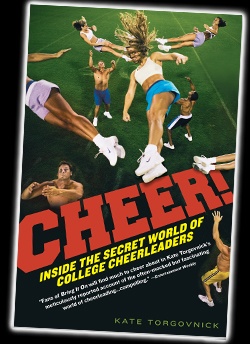
"College cheerleaders are extreme athletes who fly thirty feet in the air, build pyramids in which a single slip can send ten people crashing to the ground, and compete in National Championships that are won by hundredths of a point. Cheer! is a year-long odyssey into their universe, following three squads from tryouts to Nationals."(via Feministing)
Sunday, December 23, 2007
The Encyclopedia of Title IX and Sports
The Encyclopedia of Title IX and Sports, edited by Nicole Mitchell and Lisa A. Ennis, was recently published by Greenwood Press. It does a great job shining the spotlight on female athletes and other leaders in women's sports. Reflecting an awareness that greatness often labors in obscurity--especially in women's sport--the authors included entries on women I had never heard of, but am happy to now know -- for example, Suzyn Waldman, the first woman to announce the play-by-play for a nationally televised baseball broadcast in 1995, Senda Abbott, PE director at Smith College who developed women's basketball in the 1890s, and Molly "Machine Gun" Bolin, the first payer to sign with the Women's Basketball League in 1978.
One slight criticism is that I would have liked a stronger explanation for why the editors chose to include biographical entries for individuals without stating their relationship to Title IX. In the preface, they say that they included women whose contributions to sport predated Title IX in order to provide a well-rounded look at women's sports, but this explanation is not satisfactory and undermines the book's utility as a Title IX resource. The authors could have made the case, for example, that Title IX influenced a cultural shift that helped create the opportunity in broadcasting that SuzynWaldman was the first woman to enjoy. They could have also suggested that Waldman's broadcast helped influence and inspire the people who were listening to support gender equity in sport, including Title IX. I think this is a missed opportunity -- the editors could have tied together the entries together by tying them more expressly to Title IX, creating a sense of interrelatedness and connectivity between early pioneers and contemporary stars, between advocates and beneficiaries.
Instead, many of the biographical entries read like a Who's Who in Women's Sport, a worthy project, to be sure, but that would have been a more accurate title. Further proving my point, is, I believe, the omission of Bernice Sandler from the biographical entries. Sandler's activism catalyzed Title IX's passage through Congress. That the Encyclopedia includes an entry for Trudy Ederle, who swam the English Channel in 1926, and not Sandler indicates that sports achievement was for the editors a stronger focus than Title IX (entries for Senator Birch Bayh and Gerald Ford notwithstanding).
Outside the context of its biographical entries, however, the Encyclopedia does a very good job profiling Title IX history and legal milestones. There are entries for every major judicial interpretation of Title IX's application to sport, as well as many of the advocacy organizations, like the Women's Sports Foundation and the National Women's Law Center, who work tirelessly to promote and protect Title IX. These entries, as well as the biographical entries described above, can serve as a useful starting point for students, journalists, or anyone starting down the research trail on issues relating to Title IX or to women's sports more generally.
One slight criticism is that I would have liked a stronger explanation for why the editors chose to include biographical entries for individuals without stating their relationship to Title IX. In the preface, they say that they included women whose contributions to sport predated Title IX in order to provide a well-rounded look at women's sports, but this explanation is not satisfactory and undermines the book's utility as a Title IX resource. The authors could have made the case, for example, that Title IX influenced a cultural shift that helped create the opportunity in broadcasting that SuzynWaldman was the first woman to enjoy. They could have also suggested that Waldman's broadcast helped influence and inspire the people who were listening to support gender equity in sport, including Title IX. I think this is a missed opportunity -- the editors could have tied together the entries together by tying them more expressly to Title IX, creating a sense of interrelatedness and connectivity between early pioneers and contemporary stars, between advocates and beneficiaries.
Instead, many of the biographical entries read like a Who's Who in Women's Sport, a worthy project, to be sure, but that would have been a more accurate title. Further proving my point, is, I believe, the omission of Bernice Sandler from the biographical entries. Sandler's activism catalyzed Title IX's passage through Congress. That the Encyclopedia includes an entry for Trudy Ederle, who swam the English Channel in 1926, and not Sandler indicates that sports achievement was for the editors a stronger focus than Title IX (entries for Senator Birch Bayh and Gerald Ford notwithstanding).
Outside the context of its biographical entries, however, the Encyclopedia does a very good job profiling Title IX history and legal milestones. There are entries for every major judicial interpretation of Title IX's application to sport, as well as many of the advocacy organizations, like the Women's Sports Foundation and the National Women's Law Center, who work tirelessly to promote and protect Title IX. These entries, as well as the biographical entries described above, can serve as a useful starting point for students, journalists, or anyone starting down the research trail on issues relating to Title IX or to women's sports more generally.
Monday, November 26, 2007
Chronicle Reviews Title IX Trilogy
The Chronicle of Higher Education (subscription req'd) recently reviewed a trio of new books about gender equality in sport. One book, Equal Play: Title IX and Social Change by Nancy Hogshead-Makar and Andrew Zimbalist, was reviewed by us here. Another, The Encyclopedia of Title IX and Sports, by Nicole Mitchell and Lisa Ennis, was described by the reviewer as "a pithy desk reference for Title IX, with brief entries on the people, organizations, and court cases that have figured prominently in the law's 35-year history."
The third book, Playing With the Boys: Why Separate Is Not Equal in Sports, by Eileen McDonagh and Laura Pappano, criticizes the sex-segregated structure of athletics and argues, according to the reviewer, "that sports teams at all levels should be integrated by gender, with sex segregation serving as the final, rather than the first, resort."
I'll definitely be getting my hands on a copy of Playing With the Boys. I agree that we over-rely on sex as a proxy for athletic ability and end up segregating sports unnecessarily in many contexts. I also agree with the authors that the presumption that girls shouldn't or can't play with boys is demeaning and ensures the second-class status of women's sports (and women, in general). So I'm interested in how far the authors take this view, and also how they address some of the mores persuasive counterarguments to an integrated model of sport. Even in this post-Title IX era, boys still get better access and more encouragement to participate in sport, and thus have an advantage over girls when it comes to developing athletic skill. As a result, there is a very real concern that selective coed sport would disproportionately exclude girls if not exclude them altogether. Relatedly, if selective sports were coed, would women be disadvantaged, at least in certain sports, because they tend to be outsized by men? If so, is the downside of lost opportunities outweighed by benefit women might collectively experience when individual women do compete on equal terms as men? I'm interested in whether and how the book addresses these questions.
The third book, Playing With the Boys: Why Separate Is Not Equal in Sports, by Eileen McDonagh and Laura Pappano, criticizes the sex-segregated structure of athletics and argues, according to the reviewer, "that sports teams at all levels should be integrated by gender, with sex segregation serving as the final, rather than the first, resort."
I'll definitely be getting my hands on a copy of Playing With the Boys. I agree that we over-rely on sex as a proxy for athletic ability and end up segregating sports unnecessarily in many contexts. I also agree with the authors that the presumption that girls shouldn't or can't play with boys is demeaning and ensures the second-class status of women's sports (and women, in general). So I'm interested in how far the authors take this view, and also how they address some of the mores persuasive counterarguments to an integrated model of sport. Even in this post-Title IX era, boys still get better access and more encouragement to participate in sport, and thus have an advantage over girls when it comes to developing athletic skill. As a result, there is a very real concern that selective coed sport would disproportionately exclude girls if not exclude them altogether. Relatedly, if selective sports were coed, would women be disadvantaged, at least in certain sports, because they tend to be outsized by men? If so, is the downside of lost opportunities outweighed by benefit women might collectively experience when individual women do compete on equal terms as men? I'm interested in whether and how the book addresses these questions.
Saturday, November 03, 2007
Equal Play: Title IX and Social Change
Professors Nancy Hogshead-Makar (Florida Coastal) and Andrew Zimbalist (Smith) have edited a new anthology called Equal Play: Title IX and Social Change. Equal Play compiles a wide variety of sources including legislative and regulatory material, judicial opinions, scholarly commentary, political commentary, and sports writing. Its presentation of this material conveys the mutually-constitutive relationship between law and culture in the area of gender equality and sport.
Part I contextualizes Title IX with excerpt from scholars like Susan Cahn and Welch Suggs and sports writers for SI and ESPN.com that convey the challenges and obstacles for female athletes prior to Title IX's inception. Part II provides a snapshot of the legal and political efforts to secure Title IX and its application to athletics. In addition to the statute, the implementing regulations, and the policy interpretation, the editors also include evidence of failed efforts to weaken or neutralize Title IX, like Senator Bayh's statement in opposition to the Tower Amendment, which had it passed would have exempted revenue-producing sports from the Title IX, and a district court opinion rejecting the NCAA's efforts to undermine Title IX's application to athletics.
Part III focuses on Title IX in in the 1980s and is appropriately titled "The Initial Backlash." The editors excerpt from the Court's Grove City College decision, which limited Title IX's applicability to programs receiving federal funds, until Congress reversed the ruling in 1987 (the legislation is also included). They also describe the NCAA's change in strategy from opposing Title IX to taking over women's sports and its governing body, the AIAW. By including an excerpt from Professor Gary Roberts's address to the Knight Commission, the authors convey that the NCAA's absorption of the AIAW expanded concern about commercialization to now include women's sport.
In Part IV the theme changes from backlash to progress as the focus shifts to the 1990s. Excerpts include the First Circuit's decision in Cohen v. Brown University, which favorably construed the three-prong test, and Mariah Burton Nelson's examination of the benefits of athletic participation for women and girls. But in Part V, the current decade, the backlash theme returns. On offense we see the National Wrestling Coach's Association, Jessica Gavora, the Department of Ed, and the Commission on Opportunity in Athletics all challenging Title IX's legality, principle, and application. On defense we see Donna de Varona and Julie Foudy, Don Sabo and Christine Grant, and the editors themselves all attempting to neutralizing the offensive strike with reason, evidence, and statistics.
By dividing up the book this way, the editors shine the spotlight on the persistent struggle to sustain and protect Title IX, an important project that countermands the popular mythology of Title IX as a thirty-five year feel-good story for girls and women in sport. The reader can't help but parallel the backlash of today and that of the 1980s and internalize the fragility of the law, which faced/faces serious legal and cultural opposition. At the same time, the progress chapters show exactly why it is so important to continue the struggle to overcome resistance backlash and fully realize the equality promise of Title IX.
Part I contextualizes Title IX with excerpt from scholars like Susan Cahn and Welch Suggs and sports writers for SI and ESPN.com that convey the challenges and obstacles for female athletes prior to Title IX's inception. Part II provides a snapshot of the legal and political efforts to secure Title IX and its application to athletics. In addition to the statute, the implementing regulations, and the policy interpretation, the editors also include evidence of failed efforts to weaken or neutralize Title IX, like Senator Bayh's statement in opposition to the Tower Amendment, which had it passed would have exempted revenue-producing sports from the Title IX, and a district court opinion rejecting the NCAA's efforts to undermine Title IX's application to athletics.
Part III focuses on Title IX in in the 1980s and is appropriately titled "The Initial Backlash." The editors excerpt from the Court's Grove City College decision, which limited Title IX's applicability to programs receiving federal funds, until Congress reversed the ruling in 1987 (the legislation is also included). They also describe the NCAA's change in strategy from opposing Title IX to taking over women's sports and its governing body, the AIAW. By including an excerpt from Professor Gary Roberts's address to the Knight Commission, the authors convey that the NCAA's absorption of the AIAW expanded concern about commercialization to now include women's sport.
In Part IV the theme changes from backlash to progress as the focus shifts to the 1990s. Excerpts include the First Circuit's decision in Cohen v. Brown University, which favorably construed the three-prong test, and Mariah Burton Nelson's examination of the benefits of athletic participation for women and girls. But in Part V, the current decade, the backlash theme returns. On offense we see the National Wrestling Coach's Association, Jessica Gavora, the Department of Ed, and the Commission on Opportunity in Athletics all challenging Title IX's legality, principle, and application. On defense we see Donna de Varona and Julie Foudy, Don Sabo and Christine Grant, and the editors themselves all attempting to neutralizing the offensive strike with reason, evidence, and statistics.
By dividing up the book this way, the editors shine the spotlight on the persistent struggle to sustain and protect Title IX, an important project that countermands the popular mythology of Title IX as a thirty-five year feel-good story for girls and women in sport. The reader can't help but parallel the backlash of today and that of the 1980s and internalize the fragility of the law, which faced/faces serious legal and cultural opposition. At the same time, the progress chapters show exactly why it is so important to continue the struggle to overcome resistance backlash and fully realize the equality promise of Title IX.
Friday, November 02, 2007
Librarians Turn Team Into Title IX Book Club
High school librarians in Hillsboro, Missouri, are doing their part to ensure that another generation of athletes does not grow up to emulate Jennifer Capriati -- who famously said, "I have no idea what Title IX is, sorry" in response to a reporter's question about President Bush's attempt to weaken the law.
This fall, they teamed up with the girls' volleyball coaches and assigned the team to read Let Me Play: The Story of Title IX by Karen Blumenthal. They then lead the girls in a four-part discussion of the book, which lead to many athletes discovering for the first time that their opportunities to play sports did not exist not so long ago. As Professor Linda Carpenter said in the story, it is important for girls today understand the struggle for equality so that they protect the law for the next generation.
It seems to have worked at least in Hillsboro. Inspired by the book club, the volleyball team made T-shirts that said "Ask me about Title IX" and wore them in the homecoming parade. They even challenged negative comments they received from coaches of the boys teams.
Aren't librarians great?
This fall, they teamed up with the girls' volleyball coaches and assigned the team to read Let Me Play: The Story of Title IX by Karen Blumenthal. They then lead the girls in a four-part discussion of the book, which lead to many athletes discovering for the first time that their opportunities to play sports did not exist not so long ago. As Professor Linda Carpenter said in the story, it is important for girls today understand the struggle for equality so that they protect the law for the next generation.
It seems to have worked at least in Hillsboro. Inspired by the book club, the volleyball team made T-shirts that said "Ask me about Title IX" and wore them in the homecoming parade. They even challenged negative comments they received from coaches of the boys teams.
Aren't librarians great?
Thursday, March 08, 2007
New Book

Susan Cahn, whose 1994 book Coming on Strong, is an excellent piece of sport history, has a new collection about gender and sport in the United States. Cahn has co-edited (with Jean O'Reilly from UConn) Women and Sport in the United States: A Documentary Reader. Ebuz was able to snag a copy from the publishers recently and I have enjoyed it thus far.
The editors have done an excellent job incorporating primary documents and accounts in women's sports from throughout the 20th century alongside the work of sports historians and scholars.
This article actually gives a better overview than I can right now given that I have only read a few select pieces.
Wednesday, October 11, 2006
On Zimbalist's The Bottom Line
Andrew Zimbalist is my favorite economist, and not just because he's one of Northampton's own. I ordered his new book, The Bottom Line: Observations on Sport and Business, from publisher Temple University Press. To my delight, it arrived in yesterday's mail, and thus is my Title IX topic of the day.
The Bottom Line is a collection of essays that Zimbalist has published in various publications like Sports Business Journal and the New York Times since 1998. So the book is a handy resource because it gathers these pieces all in one place. (But if you are looking for deeper treatment of economic issues in sport, and something not written for a generalist, newspaper-reading audience, you might try one of his other books.)
The collected essays address a wide range of topics on the economics of sport including stadium finance, antitrust and labor issues, the media and steroid regulation. But it's his essays on college sports and gender equity (Part V) that are of particular interest to me. In these essays Zimbalist makes a very clear, economic argument that Title IX is not victimizing men's sports (as per, e.g., yesterday's column on SI.com). First, he quantifies the steady increase in the number of male college athletes in the Title IX era. (p. 248) Second, he points out that while certain men's sports like wrestling and gymnastics have lost participants, most of this dropoff occurred between 1982 and 1992, the years when there was little or no enforcement of Title IX. (p. 266) Third, and throughout various essays, he makes a compelling case that economics is what drives athletic cuts, not gender equity. Helpfully, he itemizes expenditures of the major men's sports, like coaches' salaries, scholarships, travel, that could be redirected to other sports as an alternative to cuts. (p. 248-49, 267-68) And as a corollary to this point, he gives plenty of evidence to dispel the myth that football is a moneymaker and thus warrants special treatment under Title IX. (p. 230-32, 247-48).
So here's my bottom line. Zimbalist gathers the up the numbers and conveys them clearly, providing a much-needed balance to the public perception of the economic effects of Title IX.
The Bottom Line is a collection of essays that Zimbalist has published in various publications like Sports Business Journal and the New York Times since 1998. So the book is a handy resource because it gathers these pieces all in one place. (But if you are looking for deeper treatment of economic issues in sport, and something not written for a generalist, newspaper-reading audience, you might try one of his other books.)
The collected essays address a wide range of topics on the economics of sport including stadium finance, antitrust and labor issues, the media and steroid regulation. But it's his essays on college sports and gender equity (Part V) that are of particular interest to me. In these essays Zimbalist makes a very clear, economic argument that Title IX is not victimizing men's sports (as per, e.g., yesterday's column on SI.com). First, he quantifies the steady increase in the number of male college athletes in the Title IX era. (p. 248) Second, he points out that while certain men's sports like wrestling and gymnastics have lost participants, most of this dropoff occurred between 1982 and 1992, the years when there was little or no enforcement of Title IX. (p. 266) Third, and throughout various essays, he makes a compelling case that economics is what drives athletic cuts, not gender equity. Helpfully, he itemizes expenditures of the major men's sports, like coaches' salaries, scholarships, travel, that could be redirected to other sports as an alternative to cuts. (p. 248-49, 267-68) And as a corollary to this point, he gives plenty of evidence to dispel the myth that football is a moneymaker and thus warrants special treatment under Title IX. (p. 230-32, 247-48).
So here's my bottom line. Zimbalist gathers the up the numbers and conveys them clearly, providing a much-needed balance to the public perception of the economic effects of Title IX.
Tuesday, September 19, 2006
Schlafly and the F-word
What is striking about Phyllis Schlafly's response to the Michigan case (discussed below) is her repeated use of "feminists." Feminism and sport--women's sports--have had a strange relationship over the years. When Schlafly was out campaigning against the feminists in the 1970s, mostly in the form of anti-ERA speeches, Title IX and its proponents (most visibly the AIAW) were waging what seems to be a very separate battle. There was not much crossover between second-wavers and pro-Title IXers.
I have always found this curious and disappointing. Because I know that women campaigning for the ERA and participating in other aspects of the movement must have played sports or enagged in recreational sporting activities of some kind. It was the era of the jogging movement after all.
And I know that members of the AIAW had very feminist outlooks. Just looking at some of their visions for women's athletics indicates a very feminist influence. (Check out Playing Nice by Mary Jo Festle for the specifics.) Whether they called themselves feminist or not is uncertain. It was likely very dangerous, operating in the male-dominated world of intercollegiate athletics, to be advocating for Title IX and to call oneself a feminist in any kind of public setting. Though to me they seem inseparable, this was not the reality of the situation.
The lack of a strong feminist influence on and presence in women's sport has had its consequences, including the precarious position that Title IX occupies in the legal and cultural arenas.
I am not sure if Schlafly railed against Title IX in the 1970s while she was out stumping for the patriarchy (I am in the process of researching this) but if she did it I think it would have been quite disconcerting for the "feminists" (i.e. the participants in the second wave) to be told they were supporting Title IX and girls/women playing sports.
{If you too have a weird fascination with Phyllis Schlafly you should check out the book Republican Women: Feminism and Conservatism from Suffrage through the Rise of the New Right. She's on the cover and the author does a good job of showing how she came to power well before her anti-ERA days.}
I have always found this curious and disappointing. Because I know that women campaigning for the ERA and participating in other aspects of the movement must have played sports or enagged in recreational sporting activities of some kind. It was the era of the jogging movement after all.
And I know that members of the AIAW had very feminist outlooks. Just looking at some of their visions for women's athletics indicates a very feminist influence. (Check out Playing Nice by Mary Jo Festle for the specifics.) Whether they called themselves feminist or not is uncertain. It was likely very dangerous, operating in the male-dominated world of intercollegiate athletics, to be advocating for Title IX and to call oneself a feminist in any kind of public setting. Though to me they seem inseparable, this was not the reality of the situation.
The lack of a strong feminist influence on and presence in women's sport has had its consequences, including the precarious position that Title IX occupies in the legal and cultural arenas.
I am not sure if Schlafly railed against Title IX in the 1970s while she was out stumping for the patriarchy (I am in the process of researching this) but if she did it I think it would have been quite disconcerting for the "feminists" (i.e. the participants in the second wave) to be told they were supporting Title IX and girls/women playing sports.
{If you too have a weird fascination with Phyllis Schlafly you should check out the book Republican Women: Feminism and Conservatism from Suffrage through the Rise of the New Right. She's on the cover and the author does a good job of showing how she came to power well before her anti-ERA days.}
Subscribe to:
Posts (Atom)