Now that last week's decision in the U.C. Davis wrestling case is available online, I can offer the fuller analysis I promised.
The background, briefly, is this: In 2000, U.C. Davis decided that women would no longer be eligible to participate on the wrestling team. The female wrestlers sued, alleging discrimination by the athletic department in the overall treatment of women's athletics (in terms of scholarships, access to facilities, coaching, etc.) and failing to effectively accommodate female students with an equitable number of opportunities to participate in athletics (the three-prong test). Last year, the unequal treatment claim was dismissed as untimely in an application of the Supreme Court's controversial Ledbetter standard.
Last week, the district court dismissed the remaining ineffective accommodation claim because "plaintiffs have not alleged they gave defendant notice and an opportunity to remedy any purported systemic non-compliance with Title IX." The district court relied on a 1998 Supreme Court decision, Gebser v. Lago Vista School District, which emphasized that an institution could not be liable to a private plaintiff for money damages unless it had notice of the discrimination the plaintiff faced, and an opportunity to fix the problem.
Gebser was, of course, a sexual harassment case, and its applicability in athletics context is questionable. If a plaintiff is harassed by a teacher or another student, the discriminatory conduct that can attributed to the institution itself (and thus, subject to Title IX) is its failure to take appropriate steps to protect the plaintiff and prevent the harassment from continuing. It makes sense to emphasize the notice requirement in that context, since an institution can't reasonably be expected to prevent someone else's harassing behavior if it doesn't know about it.
In the athletics cases, however, plaintiffs are alleging discriminatory conduct in the form of institutional decisions to configure its athletics program in a certain way. It doesn't make sense to require plaintiffs to put institutions on notice of the discriminatory nature of their own decisions.
The district court cited one other case that applies Gebser's notice requirement against Title IX plaintiffs in the athletics context. That decision is Grandson v. University of Minnesota, 272 F.3d 568 (8th Cir. 2001). But from what I can tell, that is the only other one. I hope the plaintiffs appeal this decision. Perhaps we'll see a circuit split.
Decision is: Mansourian v. Board of Regents of the University of California at Davis, 2008 WL 1860031 (E.D. Cal. Apr. 23, 2008).
Friday, May 02, 2008
Thursday, May 01, 2008
Alhambra High School Softball Team Celebrates New Field
Four years ago, softball players at Alhambra (California) High School sued the Alhambra School District, challenging the disparity between their crappy softball field and the boys' new $900,000 baseball complex as a violation Title IX. After two years of litigation, the District settled, agreeing to construct a two new softball fields with "the same amenities and maintenance as the baseball fields" available to the boys.
On Tuesday, the softball team finally played their first game on the new field. The original plaintiffs, their lawyers, and school officials were all in attendance for a special ceremony to open the new field. KABC in Los Angeles covered the story on the evening news.
According to their lawyers at the California Women's Law Center and the Legal Aid Society-Employment Law Center, Cruz v. Alhambra School District was the first high school Title IX case in California.
On Tuesday, the softball team finally played their first game on the new field. The original plaintiffs, their lawyers, and school officials were all in attendance for a special ceremony to open the new field. KABC in Los Angeles covered the story on the evening news.
According to their lawyers at the California Women's Law Center and the Legal Aid Society-Employment Law Center, Cruz v. Alhambra School District was the first high school Title IX case in California.

Wednesday, April 30, 2008
New Study: Co-Ed Classrooms Benefit All Students
A new study conducted by Prof. Analia Schlosser at Tel Aviv University concludes that co-ed classrooms benefit both girls and boys by improving the classroom environment and the academic achievement of students.
Schlosser, an economist from the Eitan Berglas School of Economics at Tel Aviv University, found that "both boys and girls do better when there are more girls in the class.” She investigated girls and boys in mixed-sex classrooms in the elementary, middle, and high-school grades of the Israeli school system.
Schlosser was inspired to conduct her study after the U.S. Department of Education amended its regulations to allow for more single-sex educational options that would not (in the view of the administration) run afoul of the purpose of Title IX. Schlosser's ultimate conclusion? Boys and girls may learn differently, but American parents should think twice before moving their children to sex-segregated schools.
Schlosser, an economist from the Eitan Berglas School of Economics at Tel Aviv University, found that "both boys and girls do better when there are more girls in the class.” She investigated girls and boys in mixed-sex classrooms in the elementary, middle, and high-school grades of the Israeli school system.
Schlosser was inspired to conduct her study after the U.S. Department of Education amended its regulations to allow for more single-sex educational options that would not (in the view of the administration) run afoul of the purpose of Title IX. Schlosser's ultimate conclusion? Boys and girls may learn differently, but American parents should think twice before moving their children to sex-segregated schools.
Tuesday, April 29, 2008
Male coaches feel "discrimination"
Women's Hoops Blog links to this article about the larger implications of the search for a head women's basketball coach at University of South Carolina. The writer turns it into a battle of the sexes--a battle that men are allegedly losing because they comprise less than 50 percent of the head coaches of women's intercollegiate basketball teams and because there seems to be a trend toward hiring women for head coaching positions over more allegedly experienced male coaches.
Cry me a river. I'm sorry. I promised I would try to hold back the snarkiness but this is just ridiculous. And that Pat Summitt thinks that men should be fighting against the discrimination women faced for so many years is more than disappointing. How much longer does the winningest coach in collegiate basketball have to kowtow to the establishment? It's almost somewhat ironic given that she makes the point that should be at the forefront of this issue: “A lot of consideration should obviously be given — if abilities are equal — to women because we don’t have the same considerations if we apply for a men’s job. So, our only avenue in the women’s game, as women, is to try and put ourselves into position to be head coaches.”
What never gets questioned is the rhetoric around "equal abilities" and the "best candidate" as if these are somehow objective standards not at all influenced by our beliefs around gender, sexuality, and the meaning of sport.
USC AD Eric Hyman talks about his desire to hire a woman but that sometimes qualifications hold him back:
“All things being equal, I would want to hire a woman,” Hyman says. “All things being equal, I would want to hire a minority. All things being equal, I would hire a South Carolina graduate. I’ve always been that way.”
Hyman pauses and adds the proverbial “but.” He says he does not want to hire a minority who is less qualified than a woman, or a woman who is less qualified than a man.
“Maybe it’s not the politically correct thing to do, but it’s principles over politics,” he says.
The problem is that all things are not equal--and they never have been. These qualifications that everyone seems to think are standardized are difficult to obtain when all things--very few things in fact--are not equal.
And I wonder about this notion that principles supersede politics. Your principles should be informing your politics. And if your principles are based around the notion of winning the game at all costs then of course things like gender and racial equity look like mere "politics."
Cry me a river. I'm sorry. I promised I would try to hold back the snarkiness but this is just ridiculous. And that Pat Summitt thinks that men should be fighting against the discrimination women faced for so many years is more than disappointing. How much longer does the winningest coach in collegiate basketball have to kowtow to the establishment? It's almost somewhat ironic given that she makes the point that should be at the forefront of this issue: “A lot of consideration should obviously be given — if abilities are equal — to women because we don’t have the same considerations if we apply for a men’s job. So, our only avenue in the women’s game, as women, is to try and put ourselves into position to be head coaches.”
What never gets questioned is the rhetoric around "equal abilities" and the "best candidate" as if these are somehow objective standards not at all influenced by our beliefs around gender, sexuality, and the meaning of sport.
USC AD Eric Hyman talks about his desire to hire a woman but that sometimes qualifications hold him back:
“All things being equal, I would want to hire a woman,” Hyman says. “All things being equal, I would want to hire a minority. All things being equal, I would hire a South Carolina graduate. I’ve always been that way.”
Hyman pauses and adds the proverbial “but.” He says he does not want to hire a minority who is less qualified than a woman, or a woman who is less qualified than a man.
“Maybe it’s not the politically correct thing to do, but it’s principles over politics,” he says.
The problem is that all things are not equal--and they never have been. These qualifications that everyone seems to think are standardized are difficult to obtain when all things--very few things in fact--are not equal.
And I wonder about this notion that principles supersede politics. Your principles should be informing your politics. And if your principles are based around the notion of winning the game at all costs then of course things like gender and racial equity look like mere "politics."
Monday, April 28, 2008
West Virginia Parents Sue for Gender Equity
Parents in Mercer County, West Virginia have filed a lawsuit in federal district court against the Board of Education, alleging that inferior athletic opportunities for female students at Princeton Senior High School violate Title IX. The Bluefield Daily Telegraph reports that the complaint cites discrimination in the distribution of equipment and facilities like pitching machines and batting cages, uniforms, travel, access to coaching staff, and "other specific complaints." One example noted in the article is that boys' uniforms -- and in the case of football, even shoes -- are provided by the school, but softball and volleyball players must pay or fundraise for all or some of their gear -- including the tape to mark the volleyball court.
Sunday, April 27, 2008
Coach Jackson Fights On
After the Supreme Court confirmed in 2005 that Title IX prohibits retaliation against a coach who advocates for gender equity on behalf of his team, the defendant in that case, the Birmingham Board of Education, eventually settled with the plaintiff, former girls basketball coach Roderick Jackson. However, according to Coach Jackson, the Board has not been living up to its obligations under the settlement agreement. The Birmingham News reports that Jackson filed a motion in federal district court last week asking the judge to find the Board in contempt.
Jackson argues that, contrary to the Board's promise in the settlement agreement, female athletes at Jackson-Olin High School (and likely, other schools in the district) are still receiving inferior athletic opportunities, as measured by things like transportation, uniforms, and access to facilities.
The settlement agreement also obligated the Board to produce a Title IX compliance report. But Jackson maintains that the report is incomplete for failing to compare the financial resources provided to girls and boys sports. (The district's excuse, that it doesn't keep track of donations by "outside sources," sounds suspiciously like the "booster club made me do it" excuse we've heard many times before.) The report was also flawed, says Jackson, for only comparing the numbers of sports offered to boys and girls -- a meaningless statistic in terms of Title IX compliance -- rather than the number of athletic opportunities offered to each sex. Moreover, since Jackson-Olin High School does not satisfy that aspect of Title IX by statistical proportionality (55% of the student population is female, but receive only 36% of athletic opportunities) the report should have explained whether the district is in alternatively in compliance under one of the other two prongs.
Last, the article reports that while the settlement agreement required the Board to reinstate Jackson as head coach, Jackson is currently not serving in that position. Jackson claims this is a result of ongoing discrimination against female athletes and retaliation against him. Jackson reportedly resigned around the time of the settlement, out of concerns that his litigation was a distraction to his team. He rescinded his resignation 8 days later, and even though the Board hadn't acted on it, it refused to rehire Jackson back for the remainder of the season. Nor was he rehired for the position when it was posted for the following school year. Instead, the Board hired a football coach who some players and parents say was "treated them disrespectfully, had little basketball knowledge, and made football his priority."
Jackson argues that, contrary to the Board's promise in the settlement agreement, female athletes at Jackson-Olin High School (and likely, other schools in the district) are still receiving inferior athletic opportunities, as measured by things like transportation, uniforms, and access to facilities.
The settlement agreement also obligated the Board to produce a Title IX compliance report. But Jackson maintains that the report is incomplete for failing to compare the financial resources provided to girls and boys sports. (The district's excuse, that it doesn't keep track of donations by "outside sources," sounds suspiciously like the "booster club made me do it" excuse we've heard many times before.) The report was also flawed, says Jackson, for only comparing the numbers of sports offered to boys and girls -- a meaningless statistic in terms of Title IX compliance -- rather than the number of athletic opportunities offered to each sex. Moreover, since Jackson-Olin High School does not satisfy that aspect of Title IX by statistical proportionality (55% of the student population is female, but receive only 36% of athletic opportunities) the report should have explained whether the district is in alternatively in compliance under one of the other two prongs.
Last, the article reports that while the settlement agreement required the Board to reinstate Jackson as head coach, Jackson is currently not serving in that position. Jackson claims this is a result of ongoing discrimination against female athletes and retaliation against him. Jackson reportedly resigned around the time of the settlement, out of concerns that his litigation was a distraction to his team. He rescinded his resignation 8 days later, and even though the Board hadn't acted on it, it refused to rehire Jackson back for the remainder of the season. Nor was he rehired for the position when it was posted for the following school year. Instead, the Board hired a football coach who some players and parents say was "treated them disrespectfully, had little basketball knowledge, and made football his priority."
Saturday, April 26, 2008
Different fight for season change
In Nevada, a father of a high school soccer player has filed a suit attempting to prevent the Nevada Interscholastic Activities Association from moving girls' soccer from the winter to the fall. Only the southern half of the state has girls' soccer in this non-traditional season and the NIAA has wanted to change this for some time now in order to create a state championship in which all schools can compete.
But this father has alleged the move would be a violation of Title IX because it would mean reducing the number of sports available to girls in the winter season. And the school board seems to think this is a legitimate concern.
But if the districts in which soccer is played in the winter have not created an equitable number of opportunities for girls, switching seasons is not going to matter. It is number of opportunities--not how many exist in each season or whether the same girl can play more than one sport. The parent of the soccer player seems to be motivated by the latter. His daughter plays both soccer and volleyball--both traditional fall sports. She would have to choose if soccer moved. But the overall number of opportunities would not change assuming all teams were able to attract enough players to remain viable.
Furthermore, as we have seen in Michigan most infamously, but elsewhere, courts have viewed the scheduling of girls' sports in non-traditional seasons to be a violation of Title IX. The parents and other concerned folks in Nevada who see it the other way around will have trouble making their case should it become a legal battle.
But this father has alleged the move would be a violation of Title IX because it would mean reducing the number of sports available to girls in the winter season. And the school board seems to think this is a legitimate concern.
But if the districts in which soccer is played in the winter have not created an equitable number of opportunities for girls, switching seasons is not going to matter. It is number of opportunities--not how many exist in each season or whether the same girl can play more than one sport. The parent of the soccer player seems to be motivated by the latter. His daughter plays both soccer and volleyball--both traditional fall sports. She would have to choose if soccer moved. But the overall number of opportunities would not change assuming all teams were able to attract enough players to remain viable.
Furthermore, as we have seen in Michigan most infamously, but elsewhere, courts have viewed the scheduling of girls' sports in non-traditional seasons to be a violation of Title IX. The parents and other concerned folks in Nevada who see it the other way around will have trouble making their case should it become a legal battle.
Friday, April 25, 2008
UC Davis Wrestling Lawsuit Dismissed
Until I can find a copy of the decision to read, UC Davis's press release is going to have to do...
A prior post on the Mansourian case is here.A federal judge has ruled in favor of the University of California, Davis, in a Title IX case filed by four women who wanted to be on the intercollegiate wrestling team.
In an order issued Wednesday in Sacramento, the court held that the plaintiffs in Mansourian v. Regents of the University of California failed to give the campus notice that they were making an allegation against the entire women's intercollegiate athletic program. The plaintiffs had changed the focus of their lawsuit to allege Title IX violations in the overall program after the court dismissed their claims pertaining to the wrestling team last October, finding them to be untimely.
Wednesday, April 23, 2008
NYC Schools Contemplate Fall Season for Girls' Soccer
In New York City's Public School Athletic League, girls' soccer is a spring sport. But parents, coaches, and gender equity advocates are urging the League to move the sport to the fall, the season it is played in the rest of the state. They have already complained to the Office for Civil Rights, and according to this article, a lawsuit may be looming.
If the League is smart, it will not wait to be sued to change the season for girls' soccer. Federal courts have already ruled that nontraditional seasons can violate Title IX, if one sex is singled out for the less advantageous season. Soccer in the spring causes problems for female athletes. In addition to precluding them from participating in the state tournament, it also makes it harder for the athletes to get year-round play, a necessity for elite players seeking to develop their skills to the college level. Many development programs run in the spring to avoid conflict with and to supplement the high school season. For NYC girls, these two opportunities overlap, taxing their schedules and their bodies during the spring and leaving them with limited soccer options in the fall. Since the League schedules boys' soccer in the fall, in sync with the rest of the state, it seems this disadvantage is borne only by female athletes.
Resistance to Title IX's application here would be both futile and costly. The Michigan interscholastic athletic association litigated for years to keep girls' basketball in the spring and 5 other girls' sports in nontraditional seasons. In the end, it not only lost, but had to pay $7.4 million to the plaintiffs' attorneys. Hopefully the Public School Athletic League will avoid taking a similar approach.
If the League is smart, it will not wait to be sued to change the season for girls' soccer. Federal courts have already ruled that nontraditional seasons can violate Title IX, if one sex is singled out for the less advantageous season. Soccer in the spring causes problems for female athletes. In addition to precluding them from participating in the state tournament, it also makes it harder for the athletes to get year-round play, a necessity for elite players seeking to develop their skills to the college level. Many development programs run in the spring to avoid conflict with and to supplement the high school season. For NYC girls, these two opportunities overlap, taxing their schedules and their bodies during the spring and leaving them with limited soccer options in the fall. Since the League schedules boys' soccer in the fall, in sync with the rest of the state, it seems this disadvantage is borne only by female athletes.
Resistance to Title IX's application here would be both futile and costly. The Michigan interscholastic athletic association litigated for years to keep girls' basketball in the spring and 5 other girls' sports in nontraditional seasons. In the end, it not only lost, but had to pay $7.4 million to the plaintiffs' attorneys. Hopefully the Public School Athletic League will avoid taking a similar approach.
Tuesday, April 22, 2008
Degrees of separation: Title IX and Lorena Ochoa
Lorena Ochoa is hot, hot, hot right now just having won her fourth LPGA title in as many attempts.
But is she is product of Title IX? ESPN commentator Cindy Brunson believes so, or at least lead us to believe so when she compared Ochoa's post-Title IX accomplishments to Mickey Wright's record-setting four straight record that Ochoa tied this past weekend.
This anti liberal media* commentator finds the invocation of Title IX ridiculous in this situation because Title IX is about collegiate sports, he writes, and because Ochoa, like Wright, left college to turn professional after only two years of intercollegiate golf.
Hello, strange bedfellow.
Well I am not exactly on board with his argument. One could make a feasible argument that Ochoa benefited from the support, financial and otherwise, offered to women's golf even in just her two years of playing. Additionally he clearly does not consider how even a narrowly tailored piece of legislation can have a larger cultural impact. Might Lorena Ochoa be just as good an athlete if Title IX had never come about? Certainly. But would the coverage (even as limited as it is these days) of her successes been there without a culture--created, in part, by Title IX--that is gaining a certain amount of respect and interest in women's sport? Maybe not.
But I do have some issues with Title IX being invoked every time a female athlete does something great or record-setting. (I haven't seen any Title IX invocations post Danika Patrick's win this past weekend, thankfully.)
One, Title IX is a fairly nuanced piece of legislation--its legislative and judicial history is anyway. Such invocations erase that history and the present struggles.
Two, success in sports is more than just gender. What kind of class background does Ochoa come from? How has her race factored into her career? We love to talk about Tiger Woods's race and ethnicity but somehow when we talk about Ochoa all that gets mentioned in her gender.
These were not the arguments, of course, proffered by the conservative commentator.
*When ESPN became a bastion of "liberal media" I am not quite sure.
But is she is product of Title IX? ESPN commentator Cindy Brunson believes so, or at least lead us to believe so when she compared Ochoa's post-Title IX accomplishments to Mickey Wright's record-setting four straight record that Ochoa tied this past weekend.
This anti liberal media* commentator finds the invocation of Title IX ridiculous in this situation because Title IX is about collegiate sports, he writes, and because Ochoa, like Wright, left college to turn professional after only two years of intercollegiate golf.
Hello, strange bedfellow.
Well I am not exactly on board with his argument. One could make a feasible argument that Ochoa benefited from the support, financial and otherwise, offered to women's golf even in just her two years of playing. Additionally he clearly does not consider how even a narrowly tailored piece of legislation can have a larger cultural impact. Might Lorena Ochoa be just as good an athlete if Title IX had never come about? Certainly. But would the coverage (even as limited as it is these days) of her successes been there without a culture--created, in part, by Title IX--that is gaining a certain amount of respect and interest in women's sport? Maybe not.
But I do have some issues with Title IX being invoked every time a female athlete does something great or record-setting. (I haven't seen any Title IX invocations post Danika Patrick's win this past weekend, thankfully.)
One, Title IX is a fairly nuanced piece of legislation--its legislative and judicial history is anyway. Such invocations erase that history and the present struggles.
Two, success in sports is more than just gender. What kind of class background does Ochoa come from? How has her race factored into her career? We love to talk about Tiger Woods's race and ethnicity but somehow when we talk about Ochoa all that gets mentioned in her gender.
These were not the arguments, of course, proffered by the conservative commentator.
*When ESPN became a bastion of "liberal media" I am not quite sure.
Monday, April 21, 2008
Danica Patrick Wins Indy Japan 300
Danica Patrick, a race car driver in a field overwhelmingly dominated by men, won the Indy Japan 300 on Sunday, becoming the first woman to ever win an Indy car race. The NY Times reports that Patrick had been a popular figure on the racing scene since she placed fourth at the Indy 500 in 2005, but that this victory had put to rest doubts that she could actually win a major race. After her victory, she commented, “this reaches outside racing. This is about finding something you love to do, and following through with it.”
Of course, Patrick is not the only woman involved in car racing. Less than 24 hours after Patrick's win, driver Simona De Silvestro, the only woman in a 23-car field, earned her first win in the Champ Car developmental series.
Another female racer, Sarah Fisher, commented on Patrick's success at the Indy Japan 300: “Today marks the celebration for all of us who have chipped away at the barriers that many women have faced in fields that are dominated by men.”
Of course, Patrick is not the only woman involved in car racing. Less than 24 hours after Patrick's win, driver Simona De Silvestro, the only woman in a 23-car field, earned her first win in the Champ Car developmental series.
Another female racer, Sarah Fisher, commented on Patrick's success at the Indy Japan 300: “Today marks the celebration for all of us who have chipped away at the barriers that many women have faced in fields that are dominated by men.”
Friday, April 18, 2008
Another Lawsuit Filed Against FGCU
Florida Gulf Coast University is getting used to federal court. Yesterday it was named in yet another sex discrimination lawsuit, this one brought by former general counsel Wendy Morris, who was terminated last July.
Morris's complaint alleges that she was retaliated against by the former interim president, Richard Pegnetter for urging the University to take seriously the charges of sex discrimination raised by emerita Athletic Director Merrily Dean Baker. Rather than include Morris in the University's official response to the letter -- a response that included calling Baker's claims "unsubstantiated" before conducting any internal investigation into the veracity of her claims -- Pegnetter ensured that Morris could not even obtain a copy of the letter. After urging Pegnetter to retain an independent expert to conduct a Title IX investigation and to allow her office to assist efforts to find and correct Title IX problems, Pegnetter responded by announcing Morris's suspension in a mass email (Morris found out about the suspension from someone who forwarded the email to her). Morris then informed the Trustees of her suspicions that Pegnetter was attempting to cover up Title IX problems, including his decision to suspend her. This was a violation of a gag order that Pegnetter imposed on Morris earlier that year, in response and retaliation for her advice to the Athletics Department that it could not lawfully fire volleyball coach Jaye Flood based on the present contents of her file. (We've blogged about Morris's warnings to Assistant AD Kathy Peterson in prior posts about Flood's separate lawsuit.)
Morris was terminated soon after communicating with the Trustees.
In addition to back pay, she is seeking to ensure that the University forgo any federal funding conditioned on Title IX compliance, as well as a court order that the University comply with Title IX.
Morris's complaint alleges that she was retaliated against by the former interim president, Richard Pegnetter for urging the University to take seriously the charges of sex discrimination raised by emerita Athletic Director Merrily Dean Baker. Rather than include Morris in the University's official response to the letter -- a response that included calling Baker's claims "unsubstantiated" before conducting any internal investigation into the veracity of her claims -- Pegnetter ensured that Morris could not even obtain a copy of the letter. After urging Pegnetter to retain an independent expert to conduct a Title IX investigation and to allow her office to assist efforts to find and correct Title IX problems, Pegnetter responded by announcing Morris's suspension in a mass email (Morris found out about the suspension from someone who forwarded the email to her). Morris then informed the Trustees of her suspicions that Pegnetter was attempting to cover up Title IX problems, including his decision to suspend her. This was a violation of a gag order that Pegnetter imposed on Morris earlier that year, in response and retaliation for her advice to the Athletics Department that it could not lawfully fire volleyball coach Jaye Flood based on the present contents of her file. (We've blogged about Morris's warnings to Assistant AD Kathy Peterson in prior posts about Flood's separate lawsuit.)
Morris was terminated soon after communicating with the Trustees.
In addition to back pay, she is seeking to ensure that the University forgo any federal funding conditioned on Title IX compliance, as well as a court order that the University comply with Title IX.
We Support Fair Pay
Today, our friends at National Women's Law Center are asking bloggers to help raise awareness about the Lilly Ledbetter Fair Pay Act, which is currently pending in the Senate and is possibly up for a vote in the near future.

As the AAUW recently reported, women still only earn 69 to 80 cents on the dollar for comparable work as men. On our blog, we've written about salary disparities affecting female coaches, teachers, professors, and others employed in the education sector.
The Lilly Ledbetter Fair Pay Act (formerly the Fair Pay Restoration Act) would help ensure that the courts remain open to plaintiffs with pay discrimination claims. Last year, the Supreme Court ruled in a case called Ledbetter v. Goodyear Tire that pay discrimination plaintiffs must file suit within 18o days of the employer's initial decision upon the discriminatory salary in question. But because it understandably takes plaintiffs a couple of pay cycles -- often more than 180 days -- to realize their pay is unfair relative to that of men in similar positions, it may be too late to pursue a legal remedy once they do. The Fair Pay Restoration Act would restore what many lower courts had believed to be the law prior to the Ledbetter decision -- that each discriminatory paycheck creates a new 180 day window for the plaintiff to bring her claim. As such, it would eliminate the rigid and unnecessary obstacle to plaintiffs' claims that currently gives incentives to employers to conceal discriminatory pay policies for the statutory period and quickly immunizes them from suit.
Please urge your Senators to support the Fair Pay Restoration Act. All you have to do visit the NWLC's website -- it's quick, it's easy, and it's important.
As the AAUW recently reported, women still only earn 69 to 80 cents on the dollar for comparable work as men. On our blog, we've written about salary disparities affecting female coaches, teachers, professors, and others employed in the education sector.
The Lilly Ledbetter Fair Pay Act (formerly the Fair Pay Restoration Act) would help ensure that the courts remain open to plaintiffs with pay discrimination claims. Last year, the Supreme Court ruled in a case called Ledbetter v. Goodyear Tire that pay discrimination plaintiffs must file suit within 18o days of the employer's initial decision upon the discriminatory salary in question. But because it understandably takes plaintiffs a couple of pay cycles -- often more than 180 days -- to realize their pay is unfair relative to that of men in similar positions, it may be too late to pursue a legal remedy once they do. The Fair Pay Restoration Act would restore what many lower courts had believed to be the law prior to the Ledbetter decision -- that each discriminatory paycheck creates a new 180 day window for the plaintiff to bring her claim. As such, it would eliminate the rigid and unnecessary obstacle to plaintiffs' claims that currently gives incentives to employers to conceal discriminatory pay policies for the statutory period and quickly immunizes them from suit.
Please urge your Senators to support the Fair Pay Restoration Act. All you have to do visit the NWLC's website -- it's quick, it's easy, and it's important.
Thursday, April 17, 2008
Horseplay or Sexual Harassment?
Under Title IX, schools must take reasonable steps to students from sexual harassment by other students. When applying this standard, courts are sometimes called upon to distinguish sexual harassment from other form of bullying, teasing, roughhousing, or horseplay that aren't motivated by the sex or gender characteristics of the victim. A federal district court in Illinois recently had to make this call with respect to a practice called "sac stabbing" (getting hit in the testicles) which was inflicted on the plaintiff, a 12-year-old boy, by his teammates and peers, on an ongoing basis and with the apparent knowledge of the coach and other authority figures. The abuse exacerbated an existing medical condition, causing the plaintiff to require surgery. Even that didn't stop the abuse -- post-surgical incidents of sac stabbing popped the plaintiff's stitches.
In denying the school's motion to dismiss, the court concluded that sac stabbing in this case was sexual harassment actionable under Title IX because the facts supported a conclusion that the school's failure to protect the plaintiff from ongoing abuse was rooted in gender stereotypes. According to the complaint, the school allowed the abuse to continue based on the stereotypical perception that he was "not man enough" and that the school “essentially told [plaintiff] to toughen up and stop acting like a little girl,” to “stick up for himself.”
This decision underscores that there are a variety of ways peer harassment may contains the requisite sexual component to fall under Title IX's protection. Some focus on the abuser's motivation -- such as harassment or bullying motivated by sexual desire, the gender nonconformity of the victim, or the victim's sex directly -- while other's focus on the school's response. Regardless whether the underlying harassment is sexual harassment or asexual horseplay, a school must extend boys the same protection against harassment as it does girls; it cannot use stereotyped notions of masculinity to justify indifference to an ongoing problem.
Decision is: Doe v. Brimfield Grade School, 2008 WL 1722225 (C.D. Ill. Apr. 10, 2008)
In denying the school's motion to dismiss, the court concluded that sac stabbing in this case was sexual harassment actionable under Title IX because the facts supported a conclusion that the school's failure to protect the plaintiff from ongoing abuse was rooted in gender stereotypes. According to the complaint, the school allowed the abuse to continue based on the stereotypical perception that he was "not man enough" and that the school “essentially told [plaintiff] to toughen up and stop acting like a little girl,” to “stick up for himself.”
This decision underscores that there are a variety of ways peer harassment may contains the requisite sexual component to fall under Title IX's protection. Some focus on the abuser's motivation -- such as harassment or bullying motivated by sexual desire, the gender nonconformity of the victim, or the victim's sex directly -- while other's focus on the school's response. Regardless whether the underlying harassment is sexual harassment or asexual horseplay, a school must extend boys the same protection against harassment as it does girls; it cannot use stereotyped notions of masculinity to justify indifference to an ongoing problem.
Decision is: Doe v. Brimfield Grade School, 2008 WL 1722225 (C.D. Ill. Apr. 10, 2008)
Wednesday, April 16, 2008
URI makes cuts
As anticipated, the University of Rhode Island has been forced to cut teams to compensate for a large university-wide budget deficit. In addition to women's gymnastics which had already been told this would its last season, the university's athletic department has said it will also be eliminating women's field hockey, men's tennis, and men's swimming and diving. Also women's lacrosse will not be elevated to varsity status as had been promised when gymnastics was cut earlier in the year. Title IX expert Janet Judge helped the university as it made its final decision regarding which programs would be cut. Before the cuts URI maintained substantial proportionality. And even with the elimination of gymnastics they were not going to be too far away from that, especially given the plan to elevate lacrosse. I didn't crunch any numbers myself but I assume that Judge did and that these cuts have been made in such a way as to maintain proportionality.
Tuesday, April 15, 2008
ASU case under radar
Not too long ago we came across this post at the Huffington Post about a Title IX case at Arizona State University that we had never heard of despite its not-so-pleasant similarities to the case at University of Colorado. Ariela Migdal, in a piece about sexual assault and the campus climate, briefly mentions a case brought by a now former ASU student against the university but provides no details. The link to the ACLU, which has filed an amicus brief in the case, says more.
The woman was raped in her dorm room by a football player that the university had expelled because he was a "serial sexual harasser." But they re-admitted him and let him back in the dorms shortly after with no system in place to monitor his actions.
And that is all we have been able to find out about this case which began in 2003.
How ASU has saved itself from all the negative publicity other schools in similar situations have been subjected (or subjected themselves!) to is a mystery.
If we find out more about this one, we'll be sure to report on it.
The woman was raped in her dorm room by a football player that the university had expelled because he was a "serial sexual harasser." But they re-admitted him and let him back in the dorms shortly after with no system in place to monitor his actions.
And that is all we have been able to find out about this case which began in 2003.
How ASU has saved itself from all the negative publicity other schools in similar situations have been subjected (or subjected themselves!) to is a mystery.
If we find out more about this one, we'll be sure to report on it.
Monday, April 14, 2008
Pittsburgh Teachers Win $1.2 Million in Pay Discrimination Case
Last week a federal jury awarded $1.2 million to 12 female teachers who had sued their employer, the Elizabeth Forward School District, for discriminating against them on the basis of sex and age. The jury agreed that the plaintiffs were hired at the lowest pay grade even though they had experience from other school districts, resulting in a salary discrepancy between the plaintiffs and other comparably experienced teachers who were younger and/or male.
This was not a Title IX case; instead they chose to pursuing relief under the other federal statutes that address discrimination in the particular context of employment, including the Equal Pay Act, Title VII, and the Age Discrimination in Employment Act. They also sued under Pennsylvania's general antidiscrimination law. Last year, the District lost its effort to dismiss plaintiffs' case on summary judgment. It had argued that younger and/or male teachers were offered hiring starting salaries because they "filled a particular need," but the court noted that the District couldn't back up this generalized explanation with any specific examples of hiring decisions in which "need" was used to justify a higher salary. That district court decision paved the way for jury trial, which resulted in the $1.2 million verdict.
There's no word yet on whether the district will appeal. But it has not had much success doing so in the past. A jury awarded a $204,000 verdict in a similar case in 2005, and the district's appeal was unsuccessful. The district ended up paying about $666,000 to the plaintiffs once attorneys fees and costs were added in.
Case is: Defurio v. Elizabeth Forward School Dist., No. 05-1227 (W.D. Pa.).
Summary judgment decision is at 2007 WL 2752176 (Sept. 19, 2007).
This was not a Title IX case; instead they chose to pursuing relief under the other federal statutes that address discrimination in the particular context of employment, including the Equal Pay Act, Title VII, and the Age Discrimination in Employment Act. They also sued under Pennsylvania's general antidiscrimination law. Last year, the District lost its effort to dismiss plaintiffs' case on summary judgment. It had argued that younger and/or male teachers were offered hiring starting salaries because they "filled a particular need," but the court noted that the District couldn't back up this generalized explanation with any specific examples of hiring decisions in which "need" was used to justify a higher salary. That district court decision paved the way for jury trial, which resulted in the $1.2 million verdict.
There's no word yet on whether the district will appeal. But it has not had much success doing so in the past. A jury awarded a $204,000 verdict in a similar case in 2005, and the district's appeal was unsuccessful. The district ended up paying about $666,000 to the plaintiffs once attorneys fees and costs were added in.
Case is: Defurio v. Elizabeth Forward School Dist., No. 05-1227 (W.D. Pa.).
Summary judgment decision is at 2007 WL 2752176 (Sept. 19, 2007).
Saturday, April 12, 2008
Confusion in Bucks County
The Superintendent of the Central Bucks County School District doesn't quite understand what exactly OCR is seeking in its investigation of the district's athletic departments*.
An anonymous complaint was filed and OCR is collecting information. A representative will be meeting with the superintendent next week in an effort to resolve the complaint which centers on publicity, equipment, and scheduling.
The superintendent, who only recently found out there was a complaint filed thinking instead that the district was undergoing a routine audit process, does not seem to have a great awareness of Title IX which is disappointing given he is a high-level administrator. His confusion over the process is understandable but this statement indicates that he does not even know what Title IX is all about:
“I got the sense that a lot of it had to do with gender equity, because a lot of the questions they asked us were related to how many girls sports, how many boys sports.”
It's also unfortunate that a superintendent does not know what is happening in his own district. Asked for the publicity material he said: "They wanted all our publicity of programs. We don’t even control (game day) programs. Our parent/booster clubs do all that. They asked me how much is spent on publicity, and I said zero. … This has been very strange.”
I find it a little strange as well but for very different reasons.
*Note that this article contains a large mistake about the three-prong test at the very end. The author--who has written extensively about the Title IX issues in Pennsylvania--writes that the third prong contains 11 components.
An anonymous complaint was filed and OCR is collecting information. A representative will be meeting with the superintendent next week in an effort to resolve the complaint which centers on publicity, equipment, and scheduling.
The superintendent, who only recently found out there was a complaint filed thinking instead that the district was undergoing a routine audit process, does not seem to have a great awareness of Title IX which is disappointing given he is a high-level administrator. His confusion over the process is understandable but this statement indicates that he does not even know what Title IX is all about:
“I got the sense that a lot of it had to do with gender equity, because a lot of the questions they asked us were related to how many girls sports, how many boys sports.”
It's also unfortunate that a superintendent does not know what is happening in his own district. Asked for the publicity material he said: "They wanted all our publicity of programs. We don’t even control (game day) programs. Our parent/booster clubs do all that. They asked me how much is spent on publicity, and I said zero. … This has been very strange.”
I find it a little strange as well but for very different reasons.
*Note that this article contains a large mistake about the three-prong test at the very end. The author--who has written extensively about the Title IX issues in Pennsylvania--writes that the third prong contains 11 components.
Friday, April 11, 2008
FGCU Softball Coach Quickly Reinstated
We posted earlier this week about Florida Gulf Coast University's decision on Monday to suspend softball coach Dave Deiros after his player, Roz Tyre, complained that he grabbed her and yelled at her in a threatening manner.
On Wednesday, it was announced that Deiros had been reinstated, despite the Athletic Director's acknowledgment that "placing your hand on a student-athlete’s chest protector is not acceptable behavior."
While Deiros may be back on the job, there's reason to believe that we haven't heard the last of this incident.
First, as News-Press editorialist Deron Snyder points out, FGCU is currently defending a discrimination lawsuit brought by fired volleyball coach Jaye Flood. When Flood was accused of inappropriate contact with student -- tugging her shirt in a game -- she was investigated for five months. The fact that Deiros, a man, was quickly reinstated under similar circumstances, helps Flood make her case that the department was retaliating against her for challenging sex discrimination within the department. Snyder puts it better: "Flood’s sexual harassment case looked like a lay-up beforehand; now it looks like a two-hand slam dunk."
Second, under Title IX, universities may be liable for sexual harassment by a coach, but only if it has notice that there's a problem. Thanks to Tyre, FGCU can consider itself on notice. If Deiros ever touches Tyre or any other player again (and since there seems to be no end in sight to FGCU's sex discrimination woes, lets say this is more likely than not), FGCU is going to have a difficulty defending a Title IX suit.
On Wednesday, it was announced that Deiros had been reinstated, despite the Athletic Director's acknowledgment that "placing your hand on a student-athlete’s chest protector is not acceptable behavior."
While Deiros may be back on the job, there's reason to believe that we haven't heard the last of this incident.
First, as News-Press editorialist Deron Snyder points out, FGCU is currently defending a discrimination lawsuit brought by fired volleyball coach Jaye Flood. When Flood was accused of inappropriate contact with student -- tugging her shirt in a game -- she was investigated for five months. The fact that Deiros, a man, was quickly reinstated under similar circumstances, helps Flood make her case that the department was retaliating against her for challenging sex discrimination within the department. Snyder puts it better: "Flood’s sexual harassment case looked like a lay-up beforehand; now it looks like a two-hand slam dunk."
Second, under Title IX, universities may be liable for sexual harassment by a coach, but only if it has notice that there's a problem. Thanks to Tyre, FGCU can consider itself on notice. If Deiros ever touches Tyre or any other player again (and since there seems to be no end in sight to FGCU's sex discrimination woes, lets say this is more likely than not), FGCU is going to have a difficulty defending a Title IX suit.
Thursday, April 10, 2008
New CEO for WSF
The Women's Sports Foundation has named a new CEO. Karen Durkin who has been with the NHL most recently and the LPGA prior to that will take over the position from Donna Lopiano who resigned last summer.
Correcting the misinformation
It seems to be my purpose in life, or at least on this blog, to find all the bits of misinformation perpetuated by sport writers about Title IX, become quite irate and then correct them on this blog and often in a letter to the writer and/or editor.
Sometimes they seem very little especially when the intent clearly is not malicious (though there are plenty of those cases too). But the misinformation is presented so matter-of-factly that it is clear the writers have no idea that they are just plain wrong and that they are adding to the considerable backlash.
A few weeks ago [I lost the link, sorry] a writer in Indiana expressed sympathy for boys' volleyball which gets little recognition because it is not a sport sanctioned by the Indiana High School Athletics Association. He encouraged IHSAA to add the sport but noted that the obstacle has been Title IX which mandates state athletic associations sanction the same number of boys' and girls' sports. Well not quite. Title IX's mandate for equity doesn't directly affect athletic associations--it affects the schools that belong. IHSAA has likely not sanctioned boys' volleyball because its member schools probably already have compliance problems in the area of equitable opportunities.
And then today I read a feature on a wrestler from University of New Hampshire who won a national title at the National Collegiate Wrestling Association championships. Good for him. Not so good was the writer who failed to correct the UNH coach who said that the level of competition is pretty intense at these championships because they are comprised of club teams that are former DI programs cut by Title IX. It was said in passing and was incorporated into the story in the same manner. And it is completely false as we have discussed here too many times already. It's budget and interest. And we know this is true at UNH. By the time Ebuz and I got to UNH wrestling was already a club sport, but we did go through a round of cuts that were all about the budget. UNH has since undergone another set of cuts that are again due to budget shortfalls and budget priorities that the administration will not alter. They aren't crying that Title IX forced their hand in the same way JMU has but maybe they should inform their wrestling coach about why wrestling was really cut.
Sometimes they seem very little especially when the intent clearly is not malicious (though there are plenty of those cases too). But the misinformation is presented so matter-of-factly that it is clear the writers have no idea that they are just plain wrong and that they are adding to the considerable backlash.
A few weeks ago [I lost the link, sorry] a writer in Indiana expressed sympathy for boys' volleyball which gets little recognition because it is not a sport sanctioned by the Indiana High School Athletics Association. He encouraged IHSAA to add the sport but noted that the obstacle has been Title IX which mandates state athletic associations sanction the same number of boys' and girls' sports. Well not quite. Title IX's mandate for equity doesn't directly affect athletic associations--it affects the schools that belong. IHSAA has likely not sanctioned boys' volleyball because its member schools probably already have compliance problems in the area of equitable opportunities.
And then today I read a feature on a wrestler from University of New Hampshire who won a national title at the National Collegiate Wrestling Association championships. Good for him. Not so good was the writer who failed to correct the UNH coach who said that the level of competition is pretty intense at these championships because they are comprised of club teams that are former DI programs cut by Title IX. It was said in passing and was incorporated into the story in the same manner. And it is completely false as we have discussed here too many times already. It's budget and interest. And we know this is true at UNH. By the time Ebuz and I got to UNH wrestling was already a club sport, but we did go through a round of cuts that were all about the budget. UNH has since undergone another set of cuts that are again due to budget shortfalls and budget priorities that the administration will not alter. They aren't crying that Title IX forced their hand in the same way JMU has but maybe they should inform their wrestling coach about why wrestling was really cut.
Wednesday, April 09, 2008
ACLU Wants Greene County Segregation Plan
The ACLU is invoking a state open records law to request a copy of the plan to segregate schools by sex that Greene County, Georgia, abandoned last month. Because the county indicated that it would go forward with this or a similar plan in the future, the organization is concerned that the county is relying on stereotypes and "questionable 'brain science' theories that suggest that boys and girls should be treated radically differently." The ACLU points out that there is no scientific consensus that single-sex education is beneficial to students, something recognized even by the Department of Education, whose regulatory change in 2006 paved the way for single-sex public education.
I'm glad that the ACLU is requesting the plan. If, as they suspect, it contains a demonstrably false or questionable scientific premise (or no premise at all), it will raise awareness about the absence of critical thinking around this issue.
I'm glad that the ACLU is requesting the plan. If, as they suspect, it contains a demonstrably false or questionable scientific premise (or no premise at all), it will raise awareness about the absence of critical thinking around this issue.
Tuesday, April 08, 2008
More trouble at FGCU
Yesterday, Florida Gulf Coast University reportedly suspended Dave Deiros, head softball coach, after a player charged him with assaulting her at Saturday's practice. The player, catcher Roz Tyre, filed a complaint with the campus police claiming that Deiros twice grabbed her chest protector and shook her. Tyre did not talk to the press, but according to her complaint, a verbal dispute began when she asked for permission to sit out a throwing drill due to injury:
I proceeded to go over and talk to him, where he approached me and grabbed me with both hands in a tight grip by my chest protector, in line with the sides of my breasts....I told him to let go of me now, and pushed his shoulders in my defense....He came back and grabbed me in the same manner a second time. I again told him to let go of me and to get his hands off me....I no longer felt it was a situation of coach to athlete, but man to woman.Deiros's suspension is just the latest chapter in FGCU athletic department's ongoing sex discrimination saga. Last summer, former AD Merrily Dean Baker accused the athletic department of violating Title IX by, among other things, supporting a hostile, intimidating atmosphere for female coaches. Then, last fall, FGCU suspended and then fired then-assistant coach Gina Ramacci after investigating (but failing to corroborate) charges that she had an an inappropriate relationship with a player. Ramacci is challenging her termination as discriminatory on the basis of her perceived sexual orientation. FGCU also suspended, and later terminated former head volleyball coach Jaye Flood, who has been accused of having a relationship with a student, as well as tugging on a player's shirt during a game. But she claims that the investigation and subsequent termination was really retaliation for supporting Dean Baker's report. Another former coach, Holly Vaughn, also received negative performance evaluations after supporting those charges, and since resigned. If there is, as Dean Baker says, a hostile, intimidating environment for coaches in the athletic department, perhaps this provides some context for the hostile, intimidating environment for female athletes as well.
Monday, April 07, 2008
URI considering cuts
The University of Rhode Island decided recently to cut women's gymnastics citing the decrease in the the sport's popularity in the region. At that time it promised to add women's lacrosse in 2009. But recent budget issues (every university department is being required to scale back)have made that addition nearly impossible and it seems like cutting other sports is under serious consideration.
University administrators are considering a variety of options, however, and note that cutting teams is not something they want to do but that eliminating $800,000 of the budget will be difficult without cuts even if they can come up with a plan to increase revenues. They have also said they will be consulting a Title IX expert regarding cuts.
But right now, even after cutting women's gymnastics, URI looks pretty safe. With or without gymnastics they are firmly within 5% proportionality.
Hopefully this will mean that when the decisions as to which teams to cut are made we won't be hearing a lot of "because of Title IX, URI has cut men's....." We shall see.
University administrators are considering a variety of options, however, and note that cutting teams is not something they want to do but that eliminating $800,000 of the budget will be difficult without cuts even if they can come up with a plan to increase revenues. They have also said they will be consulting a Title IX expert regarding cuts.
But right now, even after cutting women's gymnastics, URI looks pretty safe. With or without gymnastics they are firmly within 5% proportionality.
Hopefully this will mean that when the decisions as to which teams to cut are made we won't be hearing a lot of "because of Title IX, URI has cut men's....." We shall see.
Saturday, April 05, 2008
Retaliation Case Against Clark College May Proceed to Trial
Last week, the Washington state court of appeals reversed a lower court decision that had granted a summary judgment victory to Clark College (Vancouver, WA) in its litigation with former women's basketball coach, Trev Kiser. In 2002, Clark College terminated Kiser's contract. Kiser sued under Title IX and a state law, alleging that he was terminated in retaliation for complaining about the disparities between men's and women's basketball programs that related to the quality of officiating, budget, travel arrangements, and the athletic director's hostility towards the women's team. The College argued that Kiser was fired for mismanaging team funds, including possibly pocketing some of the team's per diem money and indisputably receiving reimbursement for gas he didn't pay for. A trial judge granted the College's motion for summary judgment, and Kiser appealed.
The appellate court reversed the trial court and reinstated Kiser's case. At issue on appeal was the nature and sufficiency of evidence a retaliation plaintiff needs to proffer to avoid losing at summary judgment. For an employer to win an employment discrimination case on summary judgment, it must provide conclusive and uncontroverted evidence of its nondiscriminatory explanation for firing the plaintiff. The appellate court determined that Kiser provided enough evidence to cast doubt on the College's explanation that it fired him for mismanaging funds. In particular, Kiser alleged, and the College did not deny, that the athletic director threatened Kiser with losing his job if he didn't refrain from making Title IX allegations. "This threat presents direct evidence of a nexus between the retaliatory motive and the employment decision sufficient to suggest that the College's stated reasons for termination were pretextual," said the court. This is enough to prevent the College from winning on a summary judgment. A trial is necessary to resolve the disputed questions about Clark's allegedly retaliatory motive.
Decision: Kiser v. Clark College, 2008 WL 788685 (Wash. App. Div., March 25, 2008).
The appellate court reversed the trial court and reinstated Kiser's case. At issue on appeal was the nature and sufficiency of evidence a retaliation plaintiff needs to proffer to avoid losing at summary judgment. For an employer to win an employment discrimination case on summary judgment, it must provide conclusive and uncontroverted evidence of its nondiscriminatory explanation for firing the plaintiff. The appellate court determined that Kiser provided enough evidence to cast doubt on the College's explanation that it fired him for mismanaging funds. In particular, Kiser alleged, and the College did not deny, that the athletic director threatened Kiser with losing his job if he didn't refrain from making Title IX allegations. "This threat presents direct evidence of a nexus between the retaliatory motive and the employment decision sufficient to suggest that the College's stated reasons for termination were pretextual," said the court. This is enough to prevent the College from winning on a summary judgment. A trial is necessary to resolve the disputed questions about Clark's allegedly retaliatory motive.
Decision: Kiser v. Clark College, 2008 WL 788685 (Wash. App. Div., March 25, 2008).
Friday, April 04, 2008
Student Letter Defends Title IX
As Title IX fans, we admire people who challenge the ignorant and sexist rhetoric that is often used to demonize the law and women's equality in athletics. As professors, we love it even more when the people mounting that challenge are students. So we give a Title IX Blog tip o' the hat to Notre Dame sophomore John Witty (who, a google search reveals, hails from Iowa, one of our favorite states) for penning the following letter to his student paper.
When I started reading Greg Yatarola's column, "The tyranny of Title IX," it was April 2nd, 2008, but when I looked up from my paper it was 1950. The world had gone black and white, Notre Dame hadn't admitted women, and apparently, people cared about wrestling.While I wholeheartedly applaud Mr. Witty's takedown of the sexism imbued in the prior letter, I do want to make clear my belief that wrestling and Title IX are not and need not be mutually exclusive. In fact, Title IX supporters and wrestlers should be allies. We have a common enemy in the historic and continuing practice on the part of university athletic departments to grow and increase spending for certain, privileged men's sports at the expense of both women's sports and other men's sports.
The fact that Yatarola feels that wrestling should be priority No. 1 for the University, which frankly has more important things to worry about, isn't the worst part. Even worse is the fact that he discounted every athlete, coach, staffer, or fan of women's athletics at Notre Dame and beyond. From his sweeping claims that men are physically superior, to his inappropriate and unnecessary drop-in comment about women athletes being "comfort women," Yatarola is the exact kind of person that Title IX responds to.
There are some who agree and some who disagree with Title IX, so let me try to put it into phrasing that Yatarola might understand - Title IX is a disgrace. It's an absolute injustice, for no other reason than it is a relatively small attempt to apologize and make up for the massively one-sided, unfair, and unequal past treatment of women in the collegiate atmosphere. Its embarrassing existence is a painful reminder that our society actually had to write into law something that should have been a given in the first place - women deserve equal and just treatment. Yes there are flaws present in the implementation of Title IX, but since then, our female athletes have been able to pursue professional careers in sports, Muffet McGraw and Randy Waldrum (among others) have built nationally-ranked and recognized programs, and women's athletics has grown exponentially, and this is just at Notre Dame.
It may be just my opinion, but if all we lost for this growth was a dead-weight wrestling program 16 years ago, I'd say we're doing just fine. And Greg, if you're hard up for some tough, hard-nosed, and "hopelessly working-class" competition, tune in Sunday to ESPN to see the coach with the most wins, male or female, in college basketball. Her name is Pat Summit and she's coaching the Tennessee Lady Volunteers. And to think, she wouldn't have 7 national championships and all those wins - if only Notre Dame kept a wrestling program.
Checking in with Billie Jean
Cokie Roberts has an interview with Billie Jean King in this weekend's USA Weekend magazine. They talk about the state of women's sports, Hillary Clinton, history and the future. Remember, the Sports Museum of America opens next month in Manhattan. One wing is dedicated to housing the Billie Jean King International Women's Sports Center.
In somewhat related news: softball player Jessica Mendoza has been elected the new president of the Women's Sports Foundation and will take office in 2009--after her participation in the 2008 Summer Games.
In somewhat related news: softball player Jessica Mendoza has been elected the new president of the Women's Sports Foundation and will take office in 2009--after her participation in the 2008 Summer Games.
Thursday, April 03, 2008
The not so implausible joke
April Fool's Day came and went here at the Title IX blog. At least I thought it had until I started reading this article in the University of Buffalo student newspaper about officially changing the women's team nicknames to the Lady Bulls after years of just being the Bulls. I was aghast and I did not recognize the joke right away because, frankly, so little surprises me these days about the efforts some people go to to keep women's sports in an inferior position. And the (concocted) reasoning the "article" attributed to administrators about a separate identity and greater recognition and honor and protection from being deemed too masculine are not at all unusual. They have been proffered for years as a rationale for the Lady nickname.
What finally tipped me off? The "fact" that a fan group had proposed--and the administration accepted--simply calling them the Cows, because, after all, that's what Lady Bulls are.
And now that a wave of relief has washed over me I think it's a pretty funny article and it shows that there are people out there who get just how ridiculous this practice is. Phew.
What finally tipped me off? The "fact" that a fan group had proposed--and the administration accepted--simply calling them the Cows, because, after all, that's what Lady Bulls are.
And now that a wave of relief has washed over me I think it's a pretty funny article and it shows that there are people out there who get just how ridiculous this practice is. Phew.
Wednesday, April 02, 2008
Discrimination hurts
And the hurt is going to be felt most acutely by the Michigan High School Athletic Association which was recently ordered to pay the legal fees associated with its decade plus-long battle against a group of parents who, among other things, asked that girls' sports be played in their correct seasons. A federal judge has ordered the association to pay $7.4 million in attorney fees, most of which will go to lawyer Kristen Galles who represented what became Communities for Equity.
I do not want to belittle the concerns that the judgment will potentially bankrupt the organization (depending on what kind of payment agreement Galles and MHSAA reach) which will ultimately hurt student-athletes. But readers should not forget that MHSAA had the chance to work out a settlement that would have exempted them from attorney fees. It chose to continue the 12-year battle (which cost them over $10 million) saying that it had enough money to keep fighting. They have caused a significant amount of hurt themselves in perpetuating discrimination.
It will be interesting to see one, what comes of this particular situation, and two whether this judgment has an effect on the thoughts and actions of groups that keep fighting losing battles (a court ruled against MHSAA as early as 2001) to maintain their discriminatory practices.
I do not want to belittle the concerns that the judgment will potentially bankrupt the organization (depending on what kind of payment agreement Galles and MHSAA reach) which will ultimately hurt student-athletes. But readers should not forget that MHSAA had the chance to work out a settlement that would have exempted them from attorney fees. It chose to continue the 12-year battle (which cost them over $10 million) saying that it had enough money to keep fighting. They have caused a significant amount of hurt themselves in perpetuating discrimination.
It will be interesting to see one, what comes of this particular situation, and two whether this judgment has an effect on the thoughts and actions of groups that keep fighting losing battles (a court ruled against MHSAA as early as 2001) to maintain their discriminatory practices.
Monday, March 31, 2008
More Coverage of Sexual Harassment in College Sports
Athletic Business, a trade journal for the sports and recreation industry, examines sexual harassment in college sports in this month's issue. The article suggests that Title IX is increasingly becoming the vehicle not only for equal opportunity claims, but sexual harassment claims as well. It mentions as examples a number of cases we follow on the blog -- including the recently-settled lawsuit involving harassment by UNC women's soccer coach Anson Dorrance, the charges against FGCU volleyball coach Jaye Flood, and all of the Fresno State cases -- as well as one case we didn't know about -- a lawsuit against Hofstra in which a female student manager for the football team alleges that she was harassed by the players and fired when she complained (for more on that case, see this archived coverage by the local TV news).
The article includes quotes from Title IX expert Professor Nancy Hogshead-Makar and attorney Robert Clayton of Littler Mendelson (FGCU's counsel). Both point out that its easier in the context of athletics for comments that are normal and appropriate ("you really look like you're developing those leg muscles") to devolve into comments that contribute to a hostile environment ("you have great legs"). They advise athletic departments to avoid legal trouble by developing, implementing, and enforcing policies aimed at preventing sexual harassment from occurring and responding effectively and efficiently when harassment occurs.
The article includes quotes from Title IX expert Professor Nancy Hogshead-Makar and attorney Robert Clayton of Littler Mendelson (FGCU's counsel). Both point out that its easier in the context of athletics for comments that are normal and appropriate ("you really look like you're developing those leg muscles") to devolve into comments that contribute to a hostile environment ("you have great legs"). They advise athletic departments to avoid legal trouble by developing, implementing, and enforcing policies aimed at preventing sexual harassment from occurring and responding effectively and efficiently when harassment occurs.
Friday, March 28, 2008
ESPN2 Airs Title IX Special This Weekend
"License to Thrive: Title IX at 35" is an independently-produced, one-hour special that "examines the unique history and impact of the Title IX legislation and celebrates the achievements, in numerous areas, of women and girls over the past 35 years. "
This Sunday, March 30, it will air on ESPN2 at 1PM EST.
This Sunday, March 30, it will air on ESPN2 at 1PM EST.
Georgia County Backs Off Single-Sex Education Plan, For Now
Last month we posted about Greene County, Georgia, and its plans to convert all of its public schools to a single-sex model.
Recently, however, the County changed its mind, and will formally withdraw those plans at an upcoming meeting. According to the AP, the County faced "a groundswell of opposition from parents who were outraged that they weren't consulted ahead of time." This leaves open the possibility that the County might reinstate its plan, or some other version of the plan, after it receives input from parents and teachers.
Of course, the parents might really be outraged, not that they weren't consulted, but that the County is trying to pigeonhole their sons' and daughters' attitudes and behaviors based on gender stereotypes. In that case, their buy-in might be hard to come by.
UPDATE 4/1: The link to the AP story above is no longer working, but other news outlets reported on Greene County's change of heart, see here and here.
Recently, however, the County changed its mind, and will formally withdraw those plans at an upcoming meeting. According to the AP, the County faced "a groundswell of opposition from parents who were outraged that they weren't consulted ahead of time." This leaves open the possibility that the County might reinstate its plan, or some other version of the plan, after it receives input from parents and teachers.
Of course, the parents might really be outraged, not that they weren't consulted, but that the County is trying to pigeonhole their sons' and daughters' attitudes and behaviors based on gender stereotypes. In that case, their buy-in might be hard to come by.
UPDATE 4/1: The link to the AP story above is no longer working, but other news outlets reported on Greene County's change of heart, see here and here.
Thursday, March 27, 2008
NY Times Profiles School Bullies' Victim
In Monday's New York Times, columnist Dan Barry published this profile of Billy Wolfe, an Arkansas tenth-grader who is constantly bullied by his classmates. He's been knocked out in shop class, decked in Spanish class, prank-called, presented with a list of 20 potential assailants, encountered anti-Billy graffiti scrawled in his textbooks, and was once the subject of a Facebook page called “Every One That Hates Billy Wolfe.”
The article notes that Billy's parents have sued the bullies themselves, though that's not a likely to be a lucrative suit. They may also sue the school district, which would give a court the opportunity to construe the applicability of Title IX to this case. Meanwhile, however, stories like this one underscore the need for strengthening anti-bully legislation at the federal and state level.
It featured a photograph of Billy’s face superimposed over a likeness of Peter Pan, and provided this description of its purpose: “There is no reason anyone should like billy he’s a little bitch. And a homosexual that NO ONE LIKES.”We've noted in the past that Title IX is often limited in its capacity to address peer-on-peer violence, both because it is difficult to establish a school's deliberate indifference to ongoing bullying and because some courts don't construe sex discrimination statutes like Title IX to protect against discrimination on the basis of sexual orientation. Judging by the description of the anti-Billy Facebook page, Billy may be a target because his peers perceive him as gay or otherwise not masculine.
The article notes that Billy's parents have sued the bullies themselves, though that's not a likely to be a lucrative suit. They may also sue the school district, which would give a court the opportunity to construe the applicability of Title IX to this case. Meanwhile, however, stories like this one underscore the need for strengthening anti-bully legislation at the federal and state level.
New book on women and science
Published at the end of last year, Who's Afraid of Marie Curie?: The Challenges Facing Women in Science and Technology, written by science writer Linley Erin Hall, addresses the many challenges women face in the field. Hall's book is aimed at a general audience and includes interviews with nearly 100 women who do or have worked in science, mathematics, technology, engineering, and medicine; studies about the "differences" in men's and women's abilities in the field, and, of course, the sociocultural pressures and barriers unique to women.
I haven't read the book yet myself but the review in the current edition of Bitch (the link is to the magazine's website but the review is not available there) is quite favorable--and it references Title IX, though it's not clear that the book itself invokes the statute.
Feminist Review also has a brief but positive review.
I haven't read the book yet myself but the review in the current edition of Bitch (the link is to the magazine's website but the review is not available there) is quite favorable--and it references Title IX, though it's not clear that the book itself invokes the statute.
Feminist Review also has a brief but positive review.
Wednesday, March 26, 2008
More on New Cheerleading Book
Following up on our post last week on the new book, "Cheer!" that follows three college teams vying for cheerleading's national championship, here's an interview by Salon.com with author Kate Torgovnick, where she discusses her views on cheerleading as a competitive sport and the gender stereotypes that are often attached to male and female cheerleaders. The bottom line: Torgovnick sees competitive cheerleading (as distinguished from sideline cheerleading) as akin to any other college sport, and supports its growing legitimacy in athletic circles.
Tuesday, March 25, 2008
Outside the Lines on Negative Recruiting
This week's episode of ESPN's Outside the Lines addresses negative recruiting in women's sports. In particular, the show covered how coaches exploit parents' homophobia to lure recruits away from teams coached by women who, especially when single, are vulnerable to the lesbian "stigma."
Pat Griffin wrote about the episode on her blog about LGBT Sport. She praised ESPN's efforts to bring attention to this subtle form of discrimination in women's sport that marginalized gay athletes and contributes to the underrepresentation of women among head coaches. But she also criticized the segment for "miss[ing] an important opportunity to make the point that initiatives against negative recruiting are gaining some ground." She notes that the NCAA has shown interest in taking on this issue, teaming up with NCLR to provide resources and encouragement to member institutions to adopt policies and practices that reduce instances of negative recruiting.
Pat Griffin wrote about the episode on her blog about LGBT Sport. She praised ESPN's efforts to bring attention to this subtle form of discrimination in women's sport that marginalized gay athletes and contributes to the underrepresentation of women among head coaches. But she also criticized the segment for "miss[ing] an important opportunity to make the point that initiatives against negative recruiting are gaining some ground." She notes that the NCAA has shown interest in taking on this issue, teaming up with NCLR to provide resources and encouragement to member institutions to adopt policies and practices that reduce instances of negative recruiting.
Monday, March 24, 2008
Movie Review: Kick Like a Girl
We received our copy of the new documentary, Kick Like a Girl, last week and popped in the DVD player right away. It was quite good. The star was definitely the daughter of filmmaker Jenny Mackenzie. She was quite precocious and very informed about issues of gender, as were many of the other girls on the team. Though she did admit she had to be convinced that her team, the Mighty Cheetahs, joining the boys' soccer league in Salt Lake City was actually a good idea.
The 24-minute film contains many interviews with members of the Cheetahs, their parents, boys they played against, and I believe one mother of a boy who lost to the Cheetahs. Many of the interviewees recounted stories of parents yelling at their sons "You're losing to girls!"but none of those parents seemed to want to be interviewed.
It was a very positive film. The girls knew exactly what was going on regarding the gender stereotypes they were breaking and most of the boys in the film got it too. There was no explicit message which actually became part of the problem I had with the film.
It did not seem to want to say outright that mixed gender competition is the direction we should be headed in. But by not making some statement about either (or both) the positives and negatives of mixed gender competition the message left open for viewers to take was that these girls are unique. That most girls do not desire the level of competition these girls sought and that most girls are not competitive and not as skilled. Though the movie did a good job debunking the stereotypes that have been placed on these girls--that they can't kick, for example--it fails to address how desire for competition and level of aggression or even the desire to play a sport like soccer are all affected by social norms placed on both girls and boys.
In the end it's a great story about a soccer team that changed some minds about the abilities of (some) girls. It's perfect for showing in classes because it's short, compelling and can inspire some good discussions about youth sports, mixed gender competition, and the ability of sport to alter gender stereotypes.
The 24-minute film contains many interviews with members of the Cheetahs, their parents, boys they played against, and I believe one mother of a boy who lost to the Cheetahs. Many of the interviewees recounted stories of parents yelling at their sons "You're losing to girls!"but none of those parents seemed to want to be interviewed.
It was a very positive film. The girls knew exactly what was going on regarding the gender stereotypes they were breaking and most of the boys in the film got it too. There was no explicit message which actually became part of the problem I had with the film.
It did not seem to want to say outright that mixed gender competition is the direction we should be headed in. But by not making some statement about either (or both) the positives and negatives of mixed gender competition the message left open for viewers to take was that these girls are unique. That most girls do not desire the level of competition these girls sought and that most girls are not competitive and not as skilled. Though the movie did a good job debunking the stereotypes that have been placed on these girls--that they can't kick, for example--it fails to address how desire for competition and level of aggression or even the desire to play a sport like soccer are all affected by social norms placed on both girls and boys.
In the end it's a great story about a soccer team that changed some minds about the abilities of (some) girls. It's perfect for showing in classes because it's short, compelling and can inspire some good discussions about youth sports, mixed gender competition, and the ability of sport to alter gender stereotypes.
Friday, March 21, 2008
Softball field facelifts in Maryland
Though things may not be moving much on the softball fields in Charleston, farther north in Prince George's County, Maryland 17 of the county's 22 softball fields have undergone improvements in the past couple of years. The over $1 million spent on the fields is the result of the scrutiny the county received in 2006 over Title IX compliance related to facilities. Officials are also working on increasing the overall participation of girls and, according to the article "will promote girls sports through 2008."
One would hope this is a mistake in reporting and that the plan is to promote girls' sports well beyond this year.
Thursday, March 20, 2008
For my future source collection
Someday I'm going to write an article about competitive cheer. Meanwhile, I'll add this book to my future source collection:

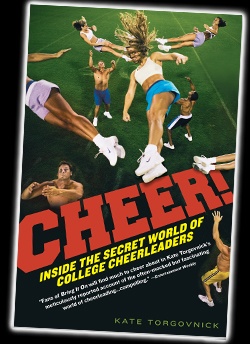
"College cheerleaders are extreme athletes who fly thirty feet in the air, build pyramids in which a single slip can send ten people crashing to the ground, and compete in National Championships that are won by hundredths of a point. Cheer! is a year-long odyssey into their universe, following three squads from tryouts to Nationals."(via Feministing)
Tuesday, March 18, 2008
Increasingly, College Housing Offers Gender Neutral Option
The Baltimore Sun reported yesterday on the increasing number of gender-neutral housing options being offered by colleges and universities. The article focuses on pilot programs underway and in the works at Goucher College, UMBC, and University of Maryland College Park, while noting that around 25 colleges (UConn among them, we've previously noted) offer students a coed living experience.
Proponents of such programs explain that some students are as comfortable, if not more so, living with members of the opposite sex, so making them choose same-sex apartment-mates seems like an "artificial barrier." Coed housing options also makes good business sense for colleges that compete with an off-campus housing market, where coed living among students is common. Last, the coed alternative is a compassionate accommodation for transgendered students, for whom living in a dorm or apartment designated for one sex or the other could be an uncomfortable (or controversial) experience.
Yet while many colleges and universities prohibit coed living, some actually require it -- for married students, that is. Last week a gay couple sued the University of Hawaii after their application to live in married student housing was denied. It's clear that many universities still order their students living arrangements around the outmoded assumptions that men and women living separately before marriage and in opposite-sex couples after marriage. The coed housing movement is helping to change this rigid, heteronormative paradigm.
Proponents of such programs explain that some students are as comfortable, if not more so, living with members of the opposite sex, so making them choose same-sex apartment-mates seems like an "artificial barrier." Coed housing options also makes good business sense for colleges that compete with an off-campus housing market, where coed living among students is common. Last, the coed alternative is a compassionate accommodation for transgendered students, for whom living in a dorm or apartment designated for one sex or the other could be an uncomfortable (or controversial) experience.
Yet while many colleges and universities prohibit coed living, some actually require it -- for married students, that is. Last week a gay couple sued the University of Hawaii after their application to live in married student housing was denied. It's clear that many universities still order their students living arrangements around the outmoded assumptions that men and women living separately before marriage and in opposite-sex couples after marriage. The coed housing movement is helping to change this rigid, heteronormative paradigm.
Monday, March 17, 2008
Elsewhere in the blogosphere
David Cohen posts at Feminist Law Profs about Cal Poly's efforts to evade Title IX by sponsoring men-only engineering classes in Saudi Arabia.
-and-
At Womenstake.org, Neena Chaudhry of the National Women's Law Coalition reflects on the three-year anniversary of the Department of Education's 2005 Clarification, which allows schools with grossly inequitable particpation opportunities to satisfy Title IX using the results of a web-based survey of female students' interests and abilities.
-and-
At Womenstake.org, Neena Chaudhry of the National Women's Law Coalition reflects on the three-year anniversary of the Department of Education's 2005 Clarification, which allows schools with grossly inequitable particpation opportunities to satisfy Title IX using the results of a web-based survey of female students' interests and abilities.
Retention still a problem at FGCU
There has not been any news out of Florida about the pending lawsuits against Florida Gulf Coast University by former female coaches. We suspect news is forthcoming, however.
There was an interesting development a few weeks ago, though, regarding the brand new golf coach. FGCU hired former LPGA pro Terry-Jo Myers to head both the women's and men's golf teams. Less than two weeks after she accepted the position which was to begin July 1, she opted to resign saying that "demands of the position" would not allow her to keep her other commitments.
It's somewhat curious and we wonder if Myers was informed or became aware of some of the issues about the environment at the school and especially in the athletic department between the time of her hiring and her resignation.
There was an interesting development a few weeks ago, though, regarding the brand new golf coach. FGCU hired former LPGA pro Terry-Jo Myers to head both the women's and men's golf teams. Less than two weeks after she accepted the position which was to begin July 1, she opted to resign saying that "demands of the position" would not allow her to keep her other commitments.
It's somewhat curious and we wonder if Myers was informed or became aware of some of the issues about the environment at the school and especially in the athletic department between the time of her hiring and her resignation.
Sunday, March 16, 2008
University of Charleston Softball Field Draws Complaint
An alumna and former softball player at the University of Charleston (West Virginia) has complained to OCR about the University's lack of progress toward improved playing conditions for the softball team.
In 2002, the University converted its softball field into a football field and moved softball to a city-owned park. In 2006, a player named Stephanie Kuhn filed a complaint with OCR, which resulted in the school's October 2006 agreement to fund upgrades to the park. Kuhn says the field was supposed to be ready for spring of 2008, and when she saw that no construction had begun, she filed another complaint.
University officials say the delay is being caused by unforeseen engineering problems, the difficulty of doing construction on land one doesn't own, and seasonal concern for mud.
In 2002, the University converted its softball field into a football field and moved softball to a city-owned park. In 2006, a player named Stephanie Kuhn filed a complaint with OCR, which resulted in the school's October 2006 agreement to fund upgrades to the park. Kuhn says the field was supposed to be ready for spring of 2008, and when she saw that no construction had begun, she filed another complaint.
University officials say the delay is being caused by unforeseen engineering problems, the difficulty of doing construction on land one doesn't own, and seasonal concern for mud.
Saturday, March 15, 2008
Wrestling at Washington community college saved--for now
Last month the board of trustees at Yakima Valley Community College delayed a vote on the potential elimination of the school's wrestling team. At that time, wrestling coach Mike Schmitt asked the board to consider adding a women's wrestling team to help move the college toward proportionality (currently the athletic opportunities for female student-athletes do not come near their 64% representation in the undergraduate population and YVCC apparently has a history with compliance that they are still trying to resolve). The former wrestling coach has agreed to donate $5,000 to start a women's club team with the hope that it will get elevated to varsity status.
Unfortunately none of the issues were addresses at the meeting yesterday because a motion to eliminate the wrestling team was never seconded leaving the whole affair unresolved.
Some are concerned about the costs of adding another team and of course the current lack of resolution of previous Title IX complaints is also weighing heavy on the school.
But there was a very curious statement made by someone at the school regarding the role of OCR in adding sports. College president Linda Kaminsky said that OCR decides what sports to add; that her talks with OCR lawyers has lead her to belief that YVCC cannot just add any sport it wants to; i.e. they might not be able to add women's wrestling even if they wanted to. She said that when the school added women's soccer in 2006 it was OCR's idea not the school's. I have never ever heard of OCR going into a school and dictating which sports a school should add. OCR has always been very hands off in such decisions. They go in and tell a school what is wrong but it is always the school's responsibility to find a solution. Either Kaminsky is confused or she is trying to deflect blame off herself and other administrators for the forthcoming (maybe?? no word on when this issue is going to be taken up next) decisions.
Friday, March 14, 2008
New documentary on mixed gender competition
A Utah woman who began coaching her daughter's soccer team several year ago has made a movie about her experiences. Kick Like a Girl was done by Jenny Mackenzie who, when her young daughter's team went unbeaten in her first season as coach, sought out teams that would provide a greater challenge: boys' teams. The 24-minute movie highlights the reaction of the girls on the Mighty Cheetahs as well as the boys they played against when the team joined the boys' league. Parents also weighed in on the girls playing boys issue--mixed reactions as you might expect.
You can find out more about the movie, where it is playing (it has been at film festivals across the country), and watch a trailer at this website.
You can also buy your own copy of the DVD for just $19.99 which includes S&H. Once we get our copy we'll do a little review.
Thursday, March 13, 2008
Some Thoughts on Competitive Cheer
As we have written about in the past, the sport of competitive cheerleading exists at both the college and high school level. To be clear, "competitive cheer" is not the same as sideline cheer, which is, for Title IX purposes, a form of publicity and promotion. But when a cheerleading squad exists for the sole purpose of training and competing against other squads throughout a regular season, it is considered by many -- including OCR, under the right circumstances -- to be a sport, entitled to all of the benefits that other sports receive. This development is controversial, however. Many have a hard time taking competitive cheer seriously -- both because it's a sport where the winner is not determined by a scoreboard or a time clock (though it's certainly not the first sport to rely on subjective scoring system), and because it invokes by association the gender stereotypes perpetuated by traditional sideline cheerleading.
Both high school and college cheer were in the news this week, inspiring me to offer some reflections on this new sport. First, there was this article in the Baltimore Sun, which profiled the competitive cheer squad at the University of Maryland. Maryland is the first, and currently only, college to offer competitive cheer as a sport. Oregon will be joining them next year. However, the article points to some evidence that this isn't necessarily the beginning of a trend. OCR ensures that schools aren't passing off their existing sideline cheerleaders as athletes under Title IX, which means schools actually have to spend money on competitive cheer, like any other sport -- a big deterrent. Additionally, one source suggested that while cheerleading squads might enjoy the occasional competition, they are reluctant to give up their sideline role, as going competitive would require.
I got a difference sense on the viability of competitive cheer by reading this column in the St. Petersburg Times. Author John Cotey reported on the inaugural Florida state championship in competitive cheer, which involved 175 schools and nearly 4,000 (all female) athletes. He made it clear while he personally doesn't fully embrace the sport -- pointing out that "bright red lipstick was apparently required," that "athletes were in curlers...[and] ribbons were part of the uniform" -- he ultimately comes out in favor competitive cheer, emphasizing that despite the spectacle (DJs, airbrushed souvenir t-shirts, roses and corsages for sale) the competition was serious. His account suggests that high school competitive cheer is, at least in Florida, a viable, sport that is catching on, and producing potential future college participants.
If competitive cheer is really catching on, the question women's sports proponents will have to ask is whether a sport that incorporates "lipstick, ribbons, and curlers" can coexist with those women's sports that challenge gender stereotypes and broaden the scope of what society considers appropriately feminine appearance, behavior, and activity. Some might say there is already pressure on female athletes to emphasize traditionally feminine appearance without embracing a sport that seems to require it. At the same time, those of us who are questioning the validity of competitive cheer should be careful not to let our paradigm of sport be limited by its traditional definitions, which were, historically speaking, created by men. Competitive cheer might represent an opportunity to expand the definition of sport, however slightly, from its patriarchal origins. I don't have a final answer, but I'm open to the possibility of competitive cheer as a feminist project.
Both high school and college cheer were in the news this week, inspiring me to offer some reflections on this new sport. First, there was this article in the Baltimore Sun, which profiled the competitive cheer squad at the University of Maryland. Maryland is the first, and currently only, college to offer competitive cheer as a sport. Oregon will be joining them next year. However, the article points to some evidence that this isn't necessarily the beginning of a trend. OCR ensures that schools aren't passing off their existing sideline cheerleaders as athletes under Title IX, which means schools actually have to spend money on competitive cheer, like any other sport -- a big deterrent. Additionally, one source suggested that while cheerleading squads might enjoy the occasional competition, they are reluctant to give up their sideline role, as going competitive would require.
I got a difference sense on the viability of competitive cheer by reading this column in the St. Petersburg Times. Author John Cotey reported on the inaugural Florida state championship in competitive cheer, which involved 175 schools and nearly 4,000 (all female) athletes. He made it clear while he personally doesn't fully embrace the sport -- pointing out that "bright red lipstick was apparently required," that "athletes were in curlers...[and] ribbons were part of the uniform" -- he ultimately comes out in favor competitive cheer, emphasizing that despite the spectacle (DJs, airbrushed souvenir t-shirts, roses and corsages for sale) the competition was serious. His account suggests that high school competitive cheer is, at least in Florida, a viable, sport that is catching on, and producing potential future college participants.
If competitive cheer is really catching on, the question women's sports proponents will have to ask is whether a sport that incorporates "lipstick, ribbons, and curlers" can coexist with those women's sports that challenge gender stereotypes and broaden the scope of what society considers appropriately feminine appearance, behavior, and activity. Some might say there is already pressure on female athletes to emphasize traditionally feminine appearance without embracing a sport that seems to require it. At the same time, those of us who are questioning the validity of competitive cheer should be careful not to let our paradigm of sport be limited by its traditional definitions, which were, historically speaking, created by men. Competitive cheer might represent an opportunity to expand the definition of sport, however slightly, from its patriarchal origins. I don't have a final answer, but I'm open to the possibility of competitive cheer as a feminist project.
Tuesday, March 11, 2008
Hogshead-Makar to help CU
As part of its multimillion dollar sexual harassment settlement last fall the University of Colorado agreed to hire a Title IX adviser and they filled that position recently with Title IX expert, author, law professor, and Olympic gold medalist Nancy Hogshead-Makar. Hogshead-Makar is keeping busy these days. She has been involved in former FGCU volleyball coach Jaye Flood's lawsuit. She also just co-edited a book with Andrew Zimbalist, Equal Play: Title IX and Social Change.
I don't suspect that she will give up her Florida commitments--like her position at Florida Coastal School of Law though the news brief was not very clear about the nature or duration of the position. Regardless, it seems she will be making some visits to Colorado as she embarks on this new job.
We here at the Title IX Blog send her many congratulations, best wishes (and maybe a pair of mittens)!
UPDATE: According to the Denver Post, Hogshead-Makar will continue to live in Florida but travel to CU to do her evaluation (which is only focused on sexual harassment; it is not a comprehensive Title IX review). Also, I should have added to her current list of projects the similar work she is doing at University of North Carolina.
The Daily Camera, CU's student newspaper, reports that it is a five-year position and that she will be taking a sabbatical next year.
I don't suspect that she will give up her Florida commitments--like her position at Florida Coastal School of Law though the news brief was not very clear about the nature or duration of the position. Regardless, it seems she will be making some visits to Colorado as she embarks on this new job.
We here at the Title IX Blog send her many congratulations, best wishes (and maybe a pair of mittens)!
UPDATE: According to the Denver Post, Hogshead-Makar will continue to live in Florida but travel to CU to do her evaluation (which is only focused on sexual harassment; it is not a comprehensive Title IX review). Also, I should have added to her current list of projects the similar work she is doing at University of North Carolina.
The Daily Camera, CU's student newspaper, reports that it is a five-year position and that she will be taking a sabbatical next year.
Monday, March 10, 2008
Milutinovich is Woman of the Year
Former Fresno State associate athletic director Diane Milutinovich will be honored today by the California State Senate as Woman of the Year for the 16th district, the Fresno Bee reported. State Senator Dean Florez nominated Milutinovich for "her many contributions to women's athletics and her unwavering fight for gender equity in higher education."
Last October, Milutinovich settled her gender discrimination lawsuit against Fresno State for $3.5 million. She retired from Fresno State after 27 year of service as a coach and administrator, but continues her advocacy for Title IX, attending all of the hearings for Senator Florez's Select Committee on Gender Discrimination.
Congrats Diane! Your honor is well-deserved.
Sunday, March 09, 2008
Professor Brake on Title IX as "Pragmatic Feminism"
When not starring in award-winning ESPN reports, Professor Deborah Brake from Pitt writes law review articles about Title IX. Her most recent is called Title IX: A Pragmatic Feminism. It is available on SSRN. I'll let the abstract speak for itself:
This paper uses Title IX as a vehicle for exploring the potential benefits of pragmatism for feminist legal theory. Title IX is unusual in antidiscrimination law for its eclectic approach to theory, drawing from liberal feminism, substantive equality, antisubordination and different voice models of equality at various points in the law's approach to gender equality in sports. This paper argues that Title IX, as a pragmatic approach to theory, provides a promising example of how feminist legal theory can draw from pragmatism to navigate the double-bind and the backlash.Citation: Deborah Brake, Title IX: A Pragmatic Feminism, 55 Cleveland State Law Review 513 (2008).
Following an introduction in Part I, Part II of this Article examines legal pragmatism and its relationship to feminist legal theory, arguing that both schools of thought have the potential to enrich one another. Part III provides an account of the multiple forms of gender oppression in sports, following pragmatism's insight that any sound theoretical approach to a problem must be grounded in the particularities of the context surrounding that problem.
Part III argues that given the slipperiness of subordination and its shifting practices and ideologies, we should not expect a unitary, consistent theory of discrimination to address it. Finally, Part IV examines the plural approach to theory reflected in Title IX, arguing that Title IX's eclectic approach to theory explains why this law has been unusually successful in navigating the double-bind and shaping cultural norms to fend off a backlash. The Article concludes that, though far from perfect, Title IX provides a promising example of how pragmatic approaches can shape successful feminist legal strategies.
Saturday, March 08, 2008
Perhaps this is the beginning of a trend?
Last week we posted about a female baseball player in Indiana winning the right to try out for baseball even though her high school has a softball team. Now, via the awesome Women's Sports Blog, we learn of a similar development in Nebraska, where the interscholastic athletic association recently voted to change its past practice of treating baseball and softball as equivalent sports. By recognizing baseball and softball as separate and distinct sports, a girl now has the opportunity to try out for baseball even if a softball team is offered at her school. Interestingly, since Nebraska high schools play softball in the fall and baseball in the spring, a female athlete may actually try out for both.
Readers may wonder whether Title IX creates an equivalent right for boys to try out for girls' softball now that they are not regarded as equivalent sports. According to the Title IX regulation (34 CFR 106.41(b)) governing cross-over participation, if a school offers only one team in a particular sport, it must let members of the opposite sex try out if athletic opportunities for that athlete's sex have "previously been limited" (and the sport involved is not a contact sport, but this limitation most likely does not include softball). There is some debate over whether this standard requires the cross-over participant to show athletic opportunities overall were previously limited (a standard boys would not be able to meet) or whether they only need to show that previous limitations in opportunities to participate in sport in question (a standard boys might be able to satisfy with respect to high school softball). There is certainly judicial support for the former interpretation, which is presumably the position that the NSAA is taking.
Readers may wonder whether Title IX creates an equivalent right for boys to try out for girls' softball now that they are not regarded as equivalent sports. According to the Title IX regulation (34 CFR 106.41(b)) governing cross-over participation, if a school offers only one team in a particular sport, it must let members of the opposite sex try out if athletic opportunities for that athlete's sex have "previously been limited" (and the sport involved is not a contact sport, but this limitation most likely does not include softball). There is some debate over whether this standard requires the cross-over participant to show athletic opportunities overall were previously limited (a standard boys would not be able to meet) or whether they only need to show that previous limitations in opportunities to participate in sport in question (a standard boys might be able to satisfy with respect to high school softball). There is certainly judicial support for the former interpretation, which is presumably the position that the NSAA is taking.
Friday, March 07, 2008
Long Beach gymnasts win back their space
A federal judge has ruled that the folks at Wilson High School who moved the the gymnastics team and their equipment out of a dedicated facility at the high school to make room for aerobics equipment (for PE classes) and weights (to be used primarily by boys' sports teams--though why only boys are using weights is questionable but alas a post for another time) violated Title IX.
This is a preliminary decision. The judge is waiting for more information to issue a final judgment. (My guess is that it will hinge on whether the school has to pay for the damage to the equipment--especially the spring floor--that occurred during the moving process.)
The gymnasts and their parents are happy, of course, and probably pretty glad they did not accept a last-minute pre-trial offer by Wilson High School that would have paid for the use of a private off-campus facility and transportation to and from that gym. This part of the story has been somewhat buried but it important, I feel, because it shows the parents' and gymnasts' commitment to equity. The off-campus facility is, from the way it has been described, a superior facility with more amenities. But the gymnasts wanted their rightful place on campus. They wanted to remain a visible part of the school's athletic community. And they seemed to be able to see the injustice in having the only dedicated facility for women on campus taken away and given to the boys. The private facility may be bigger and better equipped but they saw beyond the perks to the larger issue of fairness.
This is a preliminary decision. The judge is waiting for more information to issue a final judgment. (My guess is that it will hinge on whether the school has to pay for the damage to the equipment--especially the spring floor--that occurred during the moving process.)
The gymnasts and their parents are happy, of course, and probably pretty glad they did not accept a last-minute pre-trial offer by Wilson High School that would have paid for the use of a private off-campus facility and transportation to and from that gym. This part of the story has been somewhat buried but it important, I feel, because it shows the parents' and gymnasts' commitment to equity. The off-campus facility is, from the way it has been described, a superior facility with more amenities. But the gymnasts wanted their rightful place on campus. They wanted to remain a visible part of the school's athletic community. And they seemed to be able to see the injustice in having the only dedicated facility for women on campus taken away and given to the boys. The private facility may be bigger and better equipped but they saw beyond the perks to the larger issue of fairness.
Harvard Tests Out Women-Only Gym Hours
In response to a request from several Muslim women students, Harvard is testing out having "women-only" hours at one of its campus gyms, the AP reports. The women making the request, with support from the campus women's center, sought the women-only hours (six hours a week, at the least used gym on campus) due to Islamic dress codes that encourage a level of modesty in dress while around men; the dress code would make it difficult or impossible to exercise at the gym in a co-ed environment.
Apparently the decision has caused some controversy on the Harvard campus, where some students support the effort to accommodate the various religious needs of students, while others say that the campus environment should be about increasing access of space to everyone, not shutting men out of the gym for certain hours in the week. Harvard plans to evaluate its trial policy on gym hours at the end of the semester.
Apparently the decision has caused some controversy on the Harvard campus, where some students support the effort to accommodate the various religious needs of students, while others say that the campus environment should be about increasing access of space to everyone, not shutting men out of the gym for certain hours in the week. Harvard plans to evaluate its trial policy on gym hours at the end of the semester.
Thursday, March 06, 2008
Phys Ed Shown to Improve Academic Success
An article in USA Today reports on a new study by the Centers for Disease Control and Prevention which shows that an increase in physical education classes in grade school can boost academic success, particularly for girls. This is interesting news given the trend in public schools to cut back on gym class to make the academic curriculum more rigorous for students.
The same boost to academic success was not seen in boys who were part of the study. Susan Carlson, a CDC epidemiologist and the lead author of the study, says that there is no evidence as to why that academic boost affected only girls, but speculated that "a higher level of physical activity might be needed to yield the same result because boys are commonly more active than girls." Except for the last part, which seems to based on Carlson's conjecture more than anything else, this is very interesting news, especially for educators looking for ways to defend gym class in the face of pressure to focus on more "academic" learning.
The same boost to academic success was not seen in boys who were part of the study. Susan Carlson, a CDC epidemiologist and the lead author of the study, says that there is no evidence as to why that academic boost affected only girls, but speculated that "a higher level of physical activity might be needed to yield the same result because boys are commonly more active than girls." Except for the last part, which seems to based on Carlson's conjecture more than anything else, this is very interesting news, especially for educators looking for ways to defend gym class in the face of pressure to focus on more "academic" learning.
Wednesday, March 05, 2008
Student Note Criticizes EADA
In 1994, Congress passed the Equity in Athletics Disclosure Act, which requires colleges and universities subject to Title IX to report information about the number of athletic opportunities it provides to both sexes as well as certain information about athletic department expenditures (and revenues) for men's and women's programs. In a note in the Journal of College and University Law, student Kathryn Keen criticizes the EADA and argues for its repeal.
First, Keen argues that the EADA is failing in its purpose of helping prospective student-athletes decide on a college, since student-athletes are not aware of the information it makes available and don't factor it into their decisionmaking. Personally, I have never heard that helping prospective student-athletes was the purpose of the EADA and the only support for this idea is a buried statement on the Department of Ed's website. The real value of disclosing gender equity data is much broader -- it is to help the public ensure that federal dollars are not funding discrimination. The EADA makes private enforcement of Title IX possible by exposing schools with gender equity problems and by giving individuals with grievances the information they need to decide whether a violation has occurred. When similar reporting requirements don't apply, violations are more easily concealed because compliance information is so difficult to acquire. This is why legislation is pending to expand these reporting requirements to high schools, which are not subject to the EADA.
Keen's more persuasive critique of the EADA is that the data schools submit is inaccurate and/or fails to conform to a uniform standard that allows for meaningful comparison. Because the statute does not require schools to employ standard accounting practices, schools have some flexibility to generate a more favorable fiscal picture. For example, they may distinguish, and thus exclude, capital expenditures, which makes capital-intensive sports (like football) appear more profitable. Even when schools aren't deliberately manipulating financial data, by innocently assigning a particular expenditure to a different budget category than other schools, they make it difficult to make comparisons and spot trends. (Compare, for example, a school that accounts for utilities as a department expense and a school that apportions the bill to its men's and women's athletics programs based on their relative use.) Moreover, there is also no audit process or other mechanism for the Department of Education to catch and correct even obvious, plain errors, such as a $34 million data entry mistake in a report filed by the University of Texas. And, though Keen looked at the reporting of financial information, not the reporting of number athletic opportunities, we've had opportunity to note, there are even reporting discrepancies there as well.
But while I agree with Keen that the EADA is flawed in this regard, I don't agree with her conclusion that the statute should be scrapped. I think that the transparency the statute provides is enormously valuable, not necessarily to prospective students (though this is probably somewhat and increasingly so), but to the public at large. Information is the foundation for private enforcement, which has been demonstrably more effective than agency enforcement at bringing about real improvements in gender equity. To that end, it is crucial for reported data to be accurate and standardized. Rather than calling for its repeal, we could seek to improve the EADA along these lines, by requiring standard accounting practices, imposing an audit system or one of peer review, by clarifying schools' obligations to include and apportion particular expenses. The NCAA, Keen points out, has already implemented a more stringent, meaningful, and accurate reporting obligation for its members (this is not a substitute for the EADA, though, since NCAA does not make its reports public). This could provide a model for the Department of Education to follow -- not to mention a retort to schools who might otherwise object that enhanced reporting requirements increase the the workload of their number-crunchers.
Citation: Kathryn Keen, The Equity in Athletics Disclosure Act: Does it Really Improve the Gender Equity Landscape?, 34 J. of College & Univ. L. 227 (2007).
First, Keen argues that the EADA is failing in its purpose of helping prospective student-athletes decide on a college, since student-athletes are not aware of the information it makes available and don't factor it into their decisionmaking. Personally, I have never heard that helping prospective student-athletes was the purpose of the EADA and the only support for this idea is a buried statement on the Department of Ed's website. The real value of disclosing gender equity data is much broader -- it is to help the public ensure that federal dollars are not funding discrimination. The EADA makes private enforcement of Title IX possible by exposing schools with gender equity problems and by giving individuals with grievances the information they need to decide whether a violation has occurred. When similar reporting requirements don't apply, violations are more easily concealed because compliance information is so difficult to acquire. This is why legislation is pending to expand these reporting requirements to high schools, which are not subject to the EADA.
Keen's more persuasive critique of the EADA is that the data schools submit is inaccurate and/or fails to conform to a uniform standard that allows for meaningful comparison. Because the statute does not require schools to employ standard accounting practices, schools have some flexibility to generate a more favorable fiscal picture. For example, they may distinguish, and thus exclude, capital expenditures, which makes capital-intensive sports (like football) appear more profitable. Even when schools aren't deliberately manipulating financial data, by innocently assigning a particular expenditure to a different budget category than other schools, they make it difficult to make comparisons and spot trends. (Compare, for example, a school that accounts for utilities as a department expense and a school that apportions the bill to its men's and women's athletics programs based on their relative use.) Moreover, there is also no audit process or other mechanism for the Department of Education to catch and correct even obvious, plain errors, such as a $34 million data entry mistake in a report filed by the University of Texas. And, though Keen looked at the reporting of financial information, not the reporting of number athletic opportunities, we've had opportunity to note, there are even reporting discrepancies there as well.
But while I agree with Keen that the EADA is flawed in this regard, I don't agree with her conclusion that the statute should be scrapped. I think that the transparency the statute provides is enormously valuable, not necessarily to prospective students (though this is probably somewhat and increasingly so), but to the public at large. Information is the foundation for private enforcement, which has been demonstrably more effective than agency enforcement at bringing about real improvements in gender equity. To that end, it is crucial for reported data to be accurate and standardized. Rather than calling for its repeal, we could seek to improve the EADA along these lines, by requiring standard accounting practices, imposing an audit system or one of peer review, by clarifying schools' obligations to include and apportion particular expenses. The NCAA, Keen points out, has already implemented a more stringent, meaningful, and accurate reporting obligation for its members (this is not a substitute for the EADA, though, since NCAA does not make its reports public). This could provide a model for the Department of Education to follow -- not to mention a retort to schools who might otherwise object that enhanced reporting requirements increase the the workload of their number-crunchers.
Citation: Kathryn Keen, The Equity in Athletics Disclosure Act: Does it Really Improve the Gender Equity Landscape?, 34 J. of College & Univ. L. 227 (2007).
Tuesday, March 04, 2008
Conference of interest
The Center for the Study of Sport in Society at Northeastern University will be holding a conference on sport and social justice in June. The Power of Sports Summit is open to scholars, activists, and those working in sport and for social justice (everyone from coaches to program coordinators/administrators) and will be held at NEU June 14 and 15. Topics to be addressed include legal issues and gender segregation but many many more (see the above link for topics and registration information). What is intriguing about this gathering is the format which will breakout groups lead by facilitators from the center. It looks to be very interactive and hopefully will draw people with a range of experiences and knowledge.
Monday, March 03, 2008
Documentary on 6-on-6 b-ball
Attention readers in Iowa: Iowa Public Television is airing what looks to be a very interesting documentary on girls' six-on-six basketball in the state. The first airing of More Than a Game was last night but it will be rebroadcast at 8:15 p.m. March 7 and on March 16 time TBA.
Times like these I miss living in Iowa. Perhaps some of our Iowa friends will tape it for us??
I would be interested to see the issues it addresses in comparison to Max McElwain's book The Only Dance in Iowa.
Times like these I miss living in Iowa. Perhaps some of our Iowa friends will tape it for us??
I would be interested to see the issues it addresses in comparison to Max McElwain's book The Only Dance in Iowa.
Sunday, March 02, 2008
New York Times on Single-Sex Education
The New York Times Magazine's cover story today is all about single-sex education. The article highlights the sharp growth in single-sex classrooms in public schools (one estimate in the article is that there were approximately 12 public schools offering single-sex programs in 2002, compared with approximately 360 today), citing a number of factors: the Department of Education's 2006 decision to promulgate regulations making it easier for districts to create single-sex classrooms without running afoul of Title IX; scientific research showing that males and females have different patterns of brain development, which some argue implicates a different learning style based on sex; the need for a more supportive environment for girls to become stronger leaders; and the sense that public schools are not doing enough to address the problem of boys failing out of school, and that perhaps single-sex education is worth a shot to see if boys' achievement improves.
Countering these arguments are numerous criticisms: that the Bush administration's encouragement of single-sex education undermines one of the primary goals of Title IX, which is to eliminate sex-based stereotypes in education; that any sex-based differences in brain development is minimal compared to individual learning preferences, and should not be interpreted in essentialist terms which would designate all boys as one type of learner, and all girls as a different type of learner; and that both boys and girls would be better served in co-educational settings by getting the individualized support necessary to be confident and to succeed academically.
I will admit to feeling conflicted about the utility of single-sex education: on the one hand, I understand the appeal of trying different techniques to encourage different types of learners, and the argument that in certain limited circumstances, a single-sex learning environment which the students (and their parents) opt into, may provide more support for certain students, and may help the students feel freed from gender stereotypes that would affect them in a co-educational setting. (This may be particularly true in the case of African-American boys, who, frankly, have been failed by public education in a number of ways).
On the other hand, the biological essentialist argument is extremely disturbing to me. One of the single-sex education proponents cited in the article, Leonard Sax, argues that human development is gendered to its core and, therefore, that boys and girls do better when separated into different classrooms. Jay Giedd, a critic of Sax's argument, points out that the biological differences between boys and girls are there, but that Sax blows their significance out of proportion. Giedd uses a good analogy: boys are, after a certain age, more likely to be taller than girls of the same age. If you decided to divide students by height, assigning the tallest 50% to use the boys' locker room, and and the shortest 50% to use the girls' locker room, "you'd end up with a better than random sort, [but] the results would be abysmal, with unacceptably large percentages of students in the wrong place."
A second problem with single-sex education is the perpetuation of gender stereotypes in how lessons are given (not the breaking down of gender stereotypes that Title IX mandates): the article discusses how in one school in Foley, Alabama which offers opt-in single-sex classrooms, an all-girls' fourth-grade class sings a song together called "Always Sisters" and then does a "tidy" experiment in measuring the relative density of oil and water, and then "confirm[s] their results with the firsthand knowledge that when you’re doing the dishes after your mother makes fried chicken, the oil always settles on top of the water in the sink." Meanwhile, their counterparts in the all-boys' classroom are discussing a story about a boy who survives a plane crash and needs to survive near a lake. Where to start with these choices on lesson plans? Why not teach the story of the plane crash AND the oil density/washing the dishes experiment to ALL of the students? Instead, the division seems to encourage boys and girls to think that they are fundamentally different, that they should care about different things in life and that they should focus on different aspects of their life outside of school as potentially helpful in the educational environment.
The story about the Foley, Ala. schools highlights the difficulty with establishing even an opt-in program: that some school districts and parents will feel entirely comfortable in perpetuating gender stereotypes in education. How to distinguish this kind of classroom from that of a different model of single-sex classroom that is able to assist in breaking down gender stereotypes is, in my view, one of the greatest challenges to establishing a potentially useful single-sex educational environment.
Under the pre-2006 Department of Education regulations, with more safeguards in place to protect against the promulgation of gender stereotypes, the Foley, Ala. curriculum might have been easier to challenge under Title IX. Under the current regulations and the attitude of the Bush administration, that's simply not the case.
Countering these arguments are numerous criticisms: that the Bush administration's encouragement of single-sex education undermines one of the primary goals of Title IX, which is to eliminate sex-based stereotypes in education; that any sex-based differences in brain development is minimal compared to individual learning preferences, and should not be interpreted in essentialist terms which would designate all boys as one type of learner, and all girls as a different type of learner; and that both boys and girls would be better served in co-educational settings by getting the individualized support necessary to be confident and to succeed academically.
I will admit to feeling conflicted about the utility of single-sex education: on the one hand, I understand the appeal of trying different techniques to encourage different types of learners, and the argument that in certain limited circumstances, a single-sex learning environment which the students (and their parents) opt into, may provide more support for certain students, and may help the students feel freed from gender stereotypes that would affect them in a co-educational setting. (This may be particularly true in the case of African-American boys, who, frankly, have been failed by public education in a number of ways).
On the other hand, the biological essentialist argument is extremely disturbing to me. One of the single-sex education proponents cited in the article, Leonard Sax, argues that human development is gendered to its core and, therefore, that boys and girls do better when separated into different classrooms. Jay Giedd, a critic of Sax's argument, points out that the biological differences between boys and girls are there, but that Sax blows their significance out of proportion. Giedd uses a good analogy: boys are, after a certain age, more likely to be taller than girls of the same age. If you decided to divide students by height, assigning the tallest 50% to use the boys' locker room, and and the shortest 50% to use the girls' locker room, "you'd end up with a better than random sort, [but] the results would be abysmal, with unacceptably large percentages of students in the wrong place."
A second problem with single-sex education is the perpetuation of gender stereotypes in how lessons are given (not the breaking down of gender stereotypes that Title IX mandates): the article discusses how in one school in Foley, Alabama which offers opt-in single-sex classrooms, an all-girls' fourth-grade class sings a song together called "Always Sisters" and then does a "tidy" experiment in measuring the relative density of oil and water, and then "confirm[s] their results with the firsthand knowledge that when you’re doing the dishes after your mother makes fried chicken, the oil always settles on top of the water in the sink." Meanwhile, their counterparts in the all-boys' classroom are discussing a story about a boy who survives a plane crash and needs to survive near a lake. Where to start with these choices on lesson plans? Why not teach the story of the plane crash AND the oil density/washing the dishes experiment to ALL of the students? Instead, the division seems to encourage boys and girls to think that they are fundamentally different, that they should care about different things in life and that they should focus on different aspects of their life outside of school as potentially helpful in the educational environment.
The story about the Foley, Ala. schools highlights the difficulty with establishing even an opt-in program: that some school districts and parents will feel entirely comfortable in perpetuating gender stereotypes in education. How to distinguish this kind of classroom from that of a different model of single-sex classroom that is able to assist in breaking down gender stereotypes is, in my view, one of the greatest challenges to establishing a potentially useful single-sex educational environment.
Under the pre-2006 Department of Education regulations, with more safeguards in place to protect against the promulgation of gender stereotypes, the Foley, Ala. curriculum might have been easier to challenge under Title IX. Under the current regulations and the attitude of the Bush administration, that's simply not the case.
Saturday, March 01, 2008
Indiana girl gets baseball tryout
After being informed of its discriminatory ways, the Indiana High School Athletic Association has waived its rule that states that a girl cannot participate in baseball if the school offers softball. Baseball player Heather Bauduin is the impetus behind the waiver. She and her lawyers from Public Justice and the law firm of Hangley Aronchick Segal & Pudlin (HASP)* threatened the IHSAA with a lawsuit if it prevented Bauduin from trying out. But in the end there was no need for a lawsuit (good for Bauduin because it allows her to participate this spring). IHSAA was apparently convinced that their rule did indeed violate Title IX and the Equal Protection Clause. [Though it is curious that Bauduin was granted a waiver. Why didn't IHSAA just abolish the rule once they knew it was discriminatory?]
This situation will hopefully begin to illustrate to everyone that softball and baseball are different sports. They have always been different. Softball was created to be a lesser version of baseball and though many of us do not view it as such, the nearly unquestioned absence and exclusion of girls (of a certain age) and women from baseball illustrates how "natural" this segregation has been.
* Sharon McKee of HASP was lead counsel on this case. McKee, who we had the pleasure of meeting last year at the Title IX conference in Cleveland, also worked with NCLR on the Jennifer Harris case.
This situation will hopefully begin to illustrate to everyone that softball and baseball are different sports. They have always been different. Softball was created to be a lesser version of baseball and though many of us do not view it as such, the nearly unquestioned absence and exclusion of girls (of a certain age) and women from baseball illustrates how "natural" this segregation has been.
* Sharon McKee of HASP was lead counsel on this case. McKee, who we had the pleasure of meeting last year at the Title IX conference in Cleveland, also worked with NCLR on the Jennifer Harris case.
Subscribe to:
Posts (Atom)