April Fool's Day came and went here at the Title IX blog. At least I thought it had until I started reading this article in the University of Buffalo student newspaper about officially changing the women's team nicknames to the Lady Bulls after years of just being the Bulls. I was aghast and I did not recognize the joke right away because, frankly, so little surprises me these days about the efforts some people go to to keep women's sports in an inferior position. And the (concocted) reasoning the "article" attributed to administrators about a separate identity and greater recognition and honor and protection from being deemed too masculine are not at all unusual. They have been proffered for years as a rationale for the Lady nickname.
What finally tipped me off? The "fact" that a fan group had proposed--and the administration accepted--simply calling them the Cows, because, after all, that's what Lady Bulls are.
And now that a wave of relief has washed over me I think it's a pretty funny article and it shows that there are people out there who get just how ridiculous this practice is. Phew.
Thursday, April 03, 2008
Wednesday, April 02, 2008
Discrimination hurts
And the hurt is going to be felt most acutely by the Michigan High School Athletic Association which was recently ordered to pay the legal fees associated with its decade plus-long battle against a group of parents who, among other things, asked that girls' sports be played in their correct seasons. A federal judge has ordered the association to pay $7.4 million in attorney fees, most of which will go to lawyer Kristen Galles who represented what became Communities for Equity.
I do not want to belittle the concerns that the judgment will potentially bankrupt the organization (depending on what kind of payment agreement Galles and MHSAA reach) which will ultimately hurt student-athletes. But readers should not forget that MHSAA had the chance to work out a settlement that would have exempted them from attorney fees. It chose to continue the 12-year battle (which cost them over $10 million) saying that it had enough money to keep fighting. They have caused a significant amount of hurt themselves in perpetuating discrimination.
It will be interesting to see one, what comes of this particular situation, and two whether this judgment has an effect on the thoughts and actions of groups that keep fighting losing battles (a court ruled against MHSAA as early as 2001) to maintain their discriminatory practices.
I do not want to belittle the concerns that the judgment will potentially bankrupt the organization (depending on what kind of payment agreement Galles and MHSAA reach) which will ultimately hurt student-athletes. But readers should not forget that MHSAA had the chance to work out a settlement that would have exempted them from attorney fees. It chose to continue the 12-year battle (which cost them over $10 million) saying that it had enough money to keep fighting. They have caused a significant amount of hurt themselves in perpetuating discrimination.
It will be interesting to see one, what comes of this particular situation, and two whether this judgment has an effect on the thoughts and actions of groups that keep fighting losing battles (a court ruled against MHSAA as early as 2001) to maintain their discriminatory practices.

Monday, March 31, 2008
More Coverage of Sexual Harassment in College Sports
Athletic Business, a trade journal for the sports and recreation industry, examines sexual harassment in college sports in this month's issue. The article suggests that Title IX is increasingly becoming the vehicle not only for equal opportunity claims, but sexual harassment claims as well. It mentions as examples a number of cases we follow on the blog -- including the recently-settled lawsuit involving harassment by UNC women's soccer coach Anson Dorrance, the charges against FGCU volleyball coach Jaye Flood, and all of the Fresno State cases -- as well as one case we didn't know about -- a lawsuit against Hofstra in which a female student manager for the football team alleges that she was harassed by the players and fired when she complained (for more on that case, see this archived coverage by the local TV news).
The article includes quotes from Title IX expert Professor Nancy Hogshead-Makar and attorney Robert Clayton of Littler Mendelson (FGCU's counsel). Both point out that its easier in the context of athletics for comments that are normal and appropriate ("you really look like you're developing those leg muscles") to devolve into comments that contribute to a hostile environment ("you have great legs"). They advise athletic departments to avoid legal trouble by developing, implementing, and enforcing policies aimed at preventing sexual harassment from occurring and responding effectively and efficiently when harassment occurs.
The article includes quotes from Title IX expert Professor Nancy Hogshead-Makar and attorney Robert Clayton of Littler Mendelson (FGCU's counsel). Both point out that its easier in the context of athletics for comments that are normal and appropriate ("you really look like you're developing those leg muscles") to devolve into comments that contribute to a hostile environment ("you have great legs"). They advise athletic departments to avoid legal trouble by developing, implementing, and enforcing policies aimed at preventing sexual harassment from occurring and responding effectively and efficiently when harassment occurs.
Friday, March 28, 2008
ESPN2 Airs Title IX Special This Weekend
"License to Thrive: Title IX at 35" is an independently-produced, one-hour special that "examines the unique history and impact of the Title IX legislation and celebrates the achievements, in numerous areas, of women and girls over the past 35 years. "
This Sunday, March 30, it will air on ESPN2 at 1PM EST.
This Sunday, March 30, it will air on ESPN2 at 1PM EST.
Georgia County Backs Off Single-Sex Education Plan, For Now
Last month we posted about Greene County, Georgia, and its plans to convert all of its public schools to a single-sex model.
Recently, however, the County changed its mind, and will formally withdraw those plans at an upcoming meeting. According to the AP, the County faced "a groundswell of opposition from parents who were outraged that they weren't consulted ahead of time." This leaves open the possibility that the County might reinstate its plan, or some other version of the plan, after it receives input from parents and teachers.
Of course, the parents might really be outraged, not that they weren't consulted, but that the County is trying to pigeonhole their sons' and daughters' attitudes and behaviors based on gender stereotypes. In that case, their buy-in might be hard to come by.
UPDATE 4/1: The link to the AP story above is no longer working, but other news outlets reported on Greene County's change of heart, see here and here.
Recently, however, the County changed its mind, and will formally withdraw those plans at an upcoming meeting. According to the AP, the County faced "a groundswell of opposition from parents who were outraged that they weren't consulted ahead of time." This leaves open the possibility that the County might reinstate its plan, or some other version of the plan, after it receives input from parents and teachers.
Of course, the parents might really be outraged, not that they weren't consulted, but that the County is trying to pigeonhole their sons' and daughters' attitudes and behaviors based on gender stereotypes. In that case, their buy-in might be hard to come by.
UPDATE 4/1: The link to the AP story above is no longer working, but other news outlets reported on Greene County's change of heart, see here and here.
Thursday, March 27, 2008
NY Times Profiles School Bullies' Victim
In Monday's New York Times, columnist Dan Barry published this profile of Billy Wolfe, an Arkansas tenth-grader who is constantly bullied by his classmates. He's been knocked out in shop class, decked in Spanish class, prank-called, presented with a list of 20 potential assailants, encountered anti-Billy graffiti scrawled in his textbooks, and was once the subject of a Facebook page called “Every One That Hates Billy Wolfe.”
The article notes that Billy's parents have sued the bullies themselves, though that's not a likely to be a lucrative suit. They may also sue the school district, which would give a court the opportunity to construe the applicability of Title IX to this case. Meanwhile, however, stories like this one underscore the need for strengthening anti-bully legislation at the federal and state level.
It featured a photograph of Billy’s face superimposed over a likeness of Peter Pan, and provided this description of its purpose: “There is no reason anyone should like billy he’s a little bitch. And a homosexual that NO ONE LIKES.”We've noted in the past that Title IX is often limited in its capacity to address peer-on-peer violence, both because it is difficult to establish a school's deliberate indifference to ongoing bullying and because some courts don't construe sex discrimination statutes like Title IX to protect against discrimination on the basis of sexual orientation. Judging by the description of the anti-Billy Facebook page, Billy may be a target because his peers perceive him as gay or otherwise not masculine.
The article notes that Billy's parents have sued the bullies themselves, though that's not a likely to be a lucrative suit. They may also sue the school district, which would give a court the opportunity to construe the applicability of Title IX to this case. Meanwhile, however, stories like this one underscore the need for strengthening anti-bully legislation at the federal and state level.
New book on women and science
Published at the end of last year, Who's Afraid of Marie Curie?: The Challenges Facing Women in Science and Technology, written by science writer Linley Erin Hall, addresses the many challenges women face in the field. Hall's book is aimed at a general audience and includes interviews with nearly 100 women who do or have worked in science, mathematics, technology, engineering, and medicine; studies about the "differences" in men's and women's abilities in the field, and, of course, the sociocultural pressures and barriers unique to women.
I haven't read the book yet myself but the review in the current edition of Bitch (the link is to the magazine's website but the review is not available there) is quite favorable--and it references Title IX, though it's not clear that the book itself invokes the statute.
Feminist Review also has a brief but positive review.
I haven't read the book yet myself but the review in the current edition of Bitch (the link is to the magazine's website but the review is not available there) is quite favorable--and it references Title IX, though it's not clear that the book itself invokes the statute.
Feminist Review also has a brief but positive review.
Wednesday, March 26, 2008
More on New Cheerleading Book
Following up on our post last week on the new book, "Cheer!" that follows three college teams vying for cheerleading's national championship, here's an interview by Salon.com with author Kate Torgovnick, where she discusses her views on cheerleading as a competitive sport and the gender stereotypes that are often attached to male and female cheerleaders. The bottom line: Torgovnick sees competitive cheerleading (as distinguished from sideline cheerleading) as akin to any other college sport, and supports its growing legitimacy in athletic circles.
Tuesday, March 25, 2008
Outside the Lines on Negative Recruiting
This week's episode of ESPN's Outside the Lines addresses negative recruiting in women's sports. In particular, the show covered how coaches exploit parents' homophobia to lure recruits away from teams coached by women who, especially when single, are vulnerable to the lesbian "stigma."
Pat Griffin wrote about the episode on her blog about LGBT Sport. She praised ESPN's efforts to bring attention to this subtle form of discrimination in women's sport that marginalized gay athletes and contributes to the underrepresentation of women among head coaches. But she also criticized the segment for "miss[ing] an important opportunity to make the point that initiatives against negative recruiting are gaining some ground." She notes that the NCAA has shown interest in taking on this issue, teaming up with NCLR to provide resources and encouragement to member institutions to adopt policies and practices that reduce instances of negative recruiting.
Pat Griffin wrote about the episode on her blog about LGBT Sport. She praised ESPN's efforts to bring attention to this subtle form of discrimination in women's sport that marginalized gay athletes and contributes to the underrepresentation of women among head coaches. But she also criticized the segment for "miss[ing] an important opportunity to make the point that initiatives against negative recruiting are gaining some ground." She notes that the NCAA has shown interest in taking on this issue, teaming up with NCLR to provide resources and encouragement to member institutions to adopt policies and practices that reduce instances of negative recruiting.
Monday, March 24, 2008
Movie Review: Kick Like a Girl
We received our copy of the new documentary, Kick Like a Girl, last week and popped in the DVD player right away. It was quite good. The star was definitely the daughter of filmmaker Jenny Mackenzie. She was quite precocious and very informed about issues of gender, as were many of the other girls on the team. Though she did admit she had to be convinced that her team, the Mighty Cheetahs, joining the boys' soccer league in Salt Lake City was actually a good idea.
The 24-minute film contains many interviews with members of the Cheetahs, their parents, boys they played against, and I believe one mother of a boy who lost to the Cheetahs. Many of the interviewees recounted stories of parents yelling at their sons "You're losing to girls!"but none of those parents seemed to want to be interviewed.
It was a very positive film. The girls knew exactly what was going on regarding the gender stereotypes they were breaking and most of the boys in the film got it too. There was no explicit message which actually became part of the problem I had with the film.
It did not seem to want to say outright that mixed gender competition is the direction we should be headed in. But by not making some statement about either (or both) the positives and negatives of mixed gender competition the message left open for viewers to take was that these girls are unique. That most girls do not desire the level of competition these girls sought and that most girls are not competitive and not as skilled. Though the movie did a good job debunking the stereotypes that have been placed on these girls--that they can't kick, for example--it fails to address how desire for competition and level of aggression or even the desire to play a sport like soccer are all affected by social norms placed on both girls and boys.
In the end it's a great story about a soccer team that changed some minds about the abilities of (some) girls. It's perfect for showing in classes because it's short, compelling and can inspire some good discussions about youth sports, mixed gender competition, and the ability of sport to alter gender stereotypes.
The 24-minute film contains many interviews with members of the Cheetahs, their parents, boys they played against, and I believe one mother of a boy who lost to the Cheetahs. Many of the interviewees recounted stories of parents yelling at their sons "You're losing to girls!"but none of those parents seemed to want to be interviewed.
It was a very positive film. The girls knew exactly what was going on regarding the gender stereotypes they were breaking and most of the boys in the film got it too. There was no explicit message which actually became part of the problem I had with the film.
It did not seem to want to say outright that mixed gender competition is the direction we should be headed in. But by not making some statement about either (or both) the positives and negatives of mixed gender competition the message left open for viewers to take was that these girls are unique. That most girls do not desire the level of competition these girls sought and that most girls are not competitive and not as skilled. Though the movie did a good job debunking the stereotypes that have been placed on these girls--that they can't kick, for example--it fails to address how desire for competition and level of aggression or even the desire to play a sport like soccer are all affected by social norms placed on both girls and boys.
In the end it's a great story about a soccer team that changed some minds about the abilities of (some) girls. It's perfect for showing in classes because it's short, compelling and can inspire some good discussions about youth sports, mixed gender competition, and the ability of sport to alter gender stereotypes.
Friday, March 21, 2008
Softball field facelifts in Maryland
Though things may not be moving much on the softball fields in Charleston, farther north in Prince George's County, Maryland 17 of the county's 22 softball fields have undergone improvements in the past couple of years. The over $1 million spent on the fields is the result of the scrutiny the county received in 2006 over Title IX compliance related to facilities. Officials are also working on increasing the overall participation of girls and, according to the article "will promote girls sports through 2008."
One would hope this is a mistake in reporting and that the plan is to promote girls' sports well beyond this year.
Thursday, March 20, 2008
For my future source collection
Someday I'm going to write an article about competitive cheer. Meanwhile, I'll add this book to my future source collection:

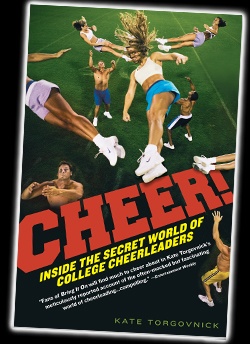
"College cheerleaders are extreme athletes who fly thirty feet in the air, build pyramids in which a single slip can send ten people crashing to the ground, and compete in National Championships that are won by hundredths of a point. Cheer! is a year-long odyssey into their universe, following three squads from tryouts to Nationals."(via Feministing)
Tuesday, March 18, 2008
Increasingly, College Housing Offers Gender Neutral Option
The Baltimore Sun reported yesterday on the increasing number of gender-neutral housing options being offered by colleges and universities. The article focuses on pilot programs underway and in the works at Goucher College, UMBC, and University of Maryland College Park, while noting that around 25 colleges (UConn among them, we've previously noted) offer students a coed living experience.
Proponents of such programs explain that some students are as comfortable, if not more so, living with members of the opposite sex, so making them choose same-sex apartment-mates seems like an "artificial barrier." Coed housing options also makes good business sense for colleges that compete with an off-campus housing market, where coed living among students is common. Last, the coed alternative is a compassionate accommodation for transgendered students, for whom living in a dorm or apartment designated for one sex or the other could be an uncomfortable (or controversial) experience.
Yet while many colleges and universities prohibit coed living, some actually require it -- for married students, that is. Last week a gay couple sued the University of Hawaii after their application to live in married student housing was denied. It's clear that many universities still order their students living arrangements around the outmoded assumptions that men and women living separately before marriage and in opposite-sex couples after marriage. The coed housing movement is helping to change this rigid, heteronormative paradigm.
Proponents of such programs explain that some students are as comfortable, if not more so, living with members of the opposite sex, so making them choose same-sex apartment-mates seems like an "artificial barrier." Coed housing options also makes good business sense for colleges that compete with an off-campus housing market, where coed living among students is common. Last, the coed alternative is a compassionate accommodation for transgendered students, for whom living in a dorm or apartment designated for one sex or the other could be an uncomfortable (or controversial) experience.
Yet while many colleges and universities prohibit coed living, some actually require it -- for married students, that is. Last week a gay couple sued the University of Hawaii after their application to live in married student housing was denied. It's clear that many universities still order their students living arrangements around the outmoded assumptions that men and women living separately before marriage and in opposite-sex couples after marriage. The coed housing movement is helping to change this rigid, heteronormative paradigm.
Monday, March 17, 2008
Elsewhere in the blogosphere
David Cohen posts at Feminist Law Profs about Cal Poly's efforts to evade Title IX by sponsoring men-only engineering classes in Saudi Arabia.
-and-
At Womenstake.org, Neena Chaudhry of the National Women's Law Coalition reflects on the three-year anniversary of the Department of Education's 2005 Clarification, which allows schools with grossly inequitable particpation opportunities to satisfy Title IX using the results of a web-based survey of female students' interests and abilities.
-and-
At Womenstake.org, Neena Chaudhry of the National Women's Law Coalition reflects on the three-year anniversary of the Department of Education's 2005 Clarification, which allows schools with grossly inequitable particpation opportunities to satisfy Title IX using the results of a web-based survey of female students' interests and abilities.
Retention still a problem at FGCU
There has not been any news out of Florida about the pending lawsuits against Florida Gulf Coast University by former female coaches. We suspect news is forthcoming, however.
There was an interesting development a few weeks ago, though, regarding the brand new golf coach. FGCU hired former LPGA pro Terry-Jo Myers to head both the women's and men's golf teams. Less than two weeks after she accepted the position which was to begin July 1, she opted to resign saying that "demands of the position" would not allow her to keep her other commitments.
It's somewhat curious and we wonder if Myers was informed or became aware of some of the issues about the environment at the school and especially in the athletic department between the time of her hiring and her resignation.
There was an interesting development a few weeks ago, though, regarding the brand new golf coach. FGCU hired former LPGA pro Terry-Jo Myers to head both the women's and men's golf teams. Less than two weeks after she accepted the position which was to begin July 1, she opted to resign saying that "demands of the position" would not allow her to keep her other commitments.
It's somewhat curious and we wonder if Myers was informed or became aware of some of the issues about the environment at the school and especially in the athletic department between the time of her hiring and her resignation.
Sunday, March 16, 2008
University of Charleston Softball Field Draws Complaint
An alumna and former softball player at the University of Charleston (West Virginia) has complained to OCR about the University's lack of progress toward improved playing conditions for the softball team.
In 2002, the University converted its softball field into a football field and moved softball to a city-owned park. In 2006, a player named Stephanie Kuhn filed a complaint with OCR, which resulted in the school's October 2006 agreement to fund upgrades to the park. Kuhn says the field was supposed to be ready for spring of 2008, and when she saw that no construction had begun, she filed another complaint.
University officials say the delay is being caused by unforeseen engineering problems, the difficulty of doing construction on land one doesn't own, and seasonal concern for mud.
In 2002, the University converted its softball field into a football field and moved softball to a city-owned park. In 2006, a player named Stephanie Kuhn filed a complaint with OCR, which resulted in the school's October 2006 agreement to fund upgrades to the park. Kuhn says the field was supposed to be ready for spring of 2008, and when she saw that no construction had begun, she filed another complaint.
University officials say the delay is being caused by unforeseen engineering problems, the difficulty of doing construction on land one doesn't own, and seasonal concern for mud.
Saturday, March 15, 2008
Wrestling at Washington community college saved--for now
Last month the board of trustees at Yakima Valley Community College delayed a vote on the potential elimination of the school's wrestling team. At that time, wrestling coach Mike Schmitt asked the board to consider adding a women's wrestling team to help move the college toward proportionality (currently the athletic opportunities for female student-athletes do not come near their 64% representation in the undergraduate population and YVCC apparently has a history with compliance that they are still trying to resolve). The former wrestling coach has agreed to donate $5,000 to start a women's club team with the hope that it will get elevated to varsity status.
Unfortunately none of the issues were addresses at the meeting yesterday because a motion to eliminate the wrestling team was never seconded leaving the whole affair unresolved.
Some are concerned about the costs of adding another team and of course the current lack of resolution of previous Title IX complaints is also weighing heavy on the school.
But there was a very curious statement made by someone at the school regarding the role of OCR in adding sports. College president Linda Kaminsky said that OCR decides what sports to add; that her talks with OCR lawyers has lead her to belief that YVCC cannot just add any sport it wants to; i.e. they might not be able to add women's wrestling even if they wanted to. She said that when the school added women's soccer in 2006 it was OCR's idea not the school's. I have never ever heard of OCR going into a school and dictating which sports a school should add. OCR has always been very hands off in such decisions. They go in and tell a school what is wrong but it is always the school's responsibility to find a solution. Either Kaminsky is confused or she is trying to deflect blame off herself and other administrators for the forthcoming (maybe?? no word on when this issue is going to be taken up next) decisions.
Friday, March 14, 2008
New documentary on mixed gender competition
A Utah woman who began coaching her daughter's soccer team several year ago has made a movie about her experiences. Kick Like a Girl was done by Jenny Mackenzie who, when her young daughter's team went unbeaten in her first season as coach, sought out teams that would provide a greater challenge: boys' teams. The 24-minute movie highlights the reaction of the girls on the Mighty Cheetahs as well as the boys they played against when the team joined the boys' league. Parents also weighed in on the girls playing boys issue--mixed reactions as you might expect.
You can find out more about the movie, where it is playing (it has been at film festivals across the country), and watch a trailer at this website.
You can also buy your own copy of the DVD for just $19.99 which includes S&H. Once we get our copy we'll do a little review.
Thursday, March 13, 2008
Some Thoughts on Competitive Cheer
As we have written about in the past, the sport of competitive cheerleading exists at both the college and high school level. To be clear, "competitive cheer" is not the same as sideline cheer, which is, for Title IX purposes, a form of publicity and promotion. But when a cheerleading squad exists for the sole purpose of training and competing against other squads throughout a regular season, it is considered by many -- including OCR, under the right circumstances -- to be a sport, entitled to all of the benefits that other sports receive. This development is controversial, however. Many have a hard time taking competitive cheer seriously -- both because it's a sport where the winner is not determined by a scoreboard or a time clock (though it's certainly not the first sport to rely on subjective scoring system), and because it invokes by association the gender stereotypes perpetuated by traditional sideline cheerleading.
Both high school and college cheer were in the news this week, inspiring me to offer some reflections on this new sport. First, there was this article in the Baltimore Sun, which profiled the competitive cheer squad at the University of Maryland. Maryland is the first, and currently only, college to offer competitive cheer as a sport. Oregon will be joining them next year. However, the article points to some evidence that this isn't necessarily the beginning of a trend. OCR ensures that schools aren't passing off their existing sideline cheerleaders as athletes under Title IX, which means schools actually have to spend money on competitive cheer, like any other sport -- a big deterrent. Additionally, one source suggested that while cheerleading squads might enjoy the occasional competition, they are reluctant to give up their sideline role, as going competitive would require.
I got a difference sense on the viability of competitive cheer by reading this column in the St. Petersburg Times. Author John Cotey reported on the inaugural Florida state championship in competitive cheer, which involved 175 schools and nearly 4,000 (all female) athletes. He made it clear while he personally doesn't fully embrace the sport -- pointing out that "bright red lipstick was apparently required," that "athletes were in curlers...[and] ribbons were part of the uniform" -- he ultimately comes out in favor competitive cheer, emphasizing that despite the spectacle (DJs, airbrushed souvenir t-shirts, roses and corsages for sale) the competition was serious. His account suggests that high school competitive cheer is, at least in Florida, a viable, sport that is catching on, and producing potential future college participants.
If competitive cheer is really catching on, the question women's sports proponents will have to ask is whether a sport that incorporates "lipstick, ribbons, and curlers" can coexist with those women's sports that challenge gender stereotypes and broaden the scope of what society considers appropriately feminine appearance, behavior, and activity. Some might say there is already pressure on female athletes to emphasize traditionally feminine appearance without embracing a sport that seems to require it. At the same time, those of us who are questioning the validity of competitive cheer should be careful not to let our paradigm of sport be limited by its traditional definitions, which were, historically speaking, created by men. Competitive cheer might represent an opportunity to expand the definition of sport, however slightly, from its patriarchal origins. I don't have a final answer, but I'm open to the possibility of competitive cheer as a feminist project.
Both high school and college cheer were in the news this week, inspiring me to offer some reflections on this new sport. First, there was this article in the Baltimore Sun, which profiled the competitive cheer squad at the University of Maryland. Maryland is the first, and currently only, college to offer competitive cheer as a sport. Oregon will be joining them next year. However, the article points to some evidence that this isn't necessarily the beginning of a trend. OCR ensures that schools aren't passing off their existing sideline cheerleaders as athletes under Title IX, which means schools actually have to spend money on competitive cheer, like any other sport -- a big deterrent. Additionally, one source suggested that while cheerleading squads might enjoy the occasional competition, they are reluctant to give up their sideline role, as going competitive would require.
I got a difference sense on the viability of competitive cheer by reading this column in the St. Petersburg Times. Author John Cotey reported on the inaugural Florida state championship in competitive cheer, which involved 175 schools and nearly 4,000 (all female) athletes. He made it clear while he personally doesn't fully embrace the sport -- pointing out that "bright red lipstick was apparently required," that "athletes were in curlers...[and] ribbons were part of the uniform" -- he ultimately comes out in favor competitive cheer, emphasizing that despite the spectacle (DJs, airbrushed souvenir t-shirts, roses and corsages for sale) the competition was serious. His account suggests that high school competitive cheer is, at least in Florida, a viable, sport that is catching on, and producing potential future college participants.
If competitive cheer is really catching on, the question women's sports proponents will have to ask is whether a sport that incorporates "lipstick, ribbons, and curlers" can coexist with those women's sports that challenge gender stereotypes and broaden the scope of what society considers appropriately feminine appearance, behavior, and activity. Some might say there is already pressure on female athletes to emphasize traditionally feminine appearance without embracing a sport that seems to require it. At the same time, those of us who are questioning the validity of competitive cheer should be careful not to let our paradigm of sport be limited by its traditional definitions, which were, historically speaking, created by men. Competitive cheer might represent an opportunity to expand the definition of sport, however slightly, from its patriarchal origins. I don't have a final answer, but I'm open to the possibility of competitive cheer as a feminist project.
Tuesday, March 11, 2008
Hogshead-Makar to help CU
As part of its multimillion dollar sexual harassment settlement last fall the University of Colorado agreed to hire a Title IX adviser and they filled that position recently with Title IX expert, author, law professor, and Olympic gold medalist Nancy Hogshead-Makar. Hogshead-Makar is keeping busy these days. She has been involved in former FGCU volleyball coach Jaye Flood's lawsuit. She also just co-edited a book with Andrew Zimbalist, Equal Play: Title IX and Social Change.
I don't suspect that she will give up her Florida commitments--like her position at Florida Coastal School of Law though the news brief was not very clear about the nature or duration of the position. Regardless, it seems she will be making some visits to Colorado as she embarks on this new job.
We here at the Title IX Blog send her many congratulations, best wishes (and maybe a pair of mittens)!
UPDATE: According to the Denver Post, Hogshead-Makar will continue to live in Florida but travel to CU to do her evaluation (which is only focused on sexual harassment; it is not a comprehensive Title IX review). Also, I should have added to her current list of projects the similar work she is doing at University of North Carolina.
The Daily Camera, CU's student newspaper, reports that it is a five-year position and that she will be taking a sabbatical next year.
I don't suspect that she will give up her Florida commitments--like her position at Florida Coastal School of Law though the news brief was not very clear about the nature or duration of the position. Regardless, it seems she will be making some visits to Colorado as she embarks on this new job.
We here at the Title IX Blog send her many congratulations, best wishes (and maybe a pair of mittens)!
UPDATE: According to the Denver Post, Hogshead-Makar will continue to live in Florida but travel to CU to do her evaluation (which is only focused on sexual harassment; it is not a comprehensive Title IX review). Also, I should have added to her current list of projects the similar work she is doing at University of North Carolina.
The Daily Camera, CU's student newspaper, reports that it is a five-year position and that she will be taking a sabbatical next year.
Subscribe to:
Posts (Atom)